Plate freezers are a cornerstone of seafood processing: they freeze bulk product quickly and consistently when controls and refrigeration systems perform as designed. But aging plate freezer controls—obsolete PLCs, unreliable sensors, or unmanaged cycle variance—can quietly erode throughput, increase product loss, and make operating schedules unpredictable.
This article helps plant managers and operations leaders identify operational symptoms that indicate a need for plate freezer controls modernization, evaluates retrofit versus replacement engineering paths, outlines control strategies to stabilise product temperature and cycle times, and describes the measurable benefits in throughput, yield, and lifecycle cost.
Technical recommendations focus on industrial refrigeration controls, automation strategies, and integration with plant electrical systems and preventive maintenance programs so you can make informed decisions about equipment upgrades or new equipment selection.
Understanding the Challenge
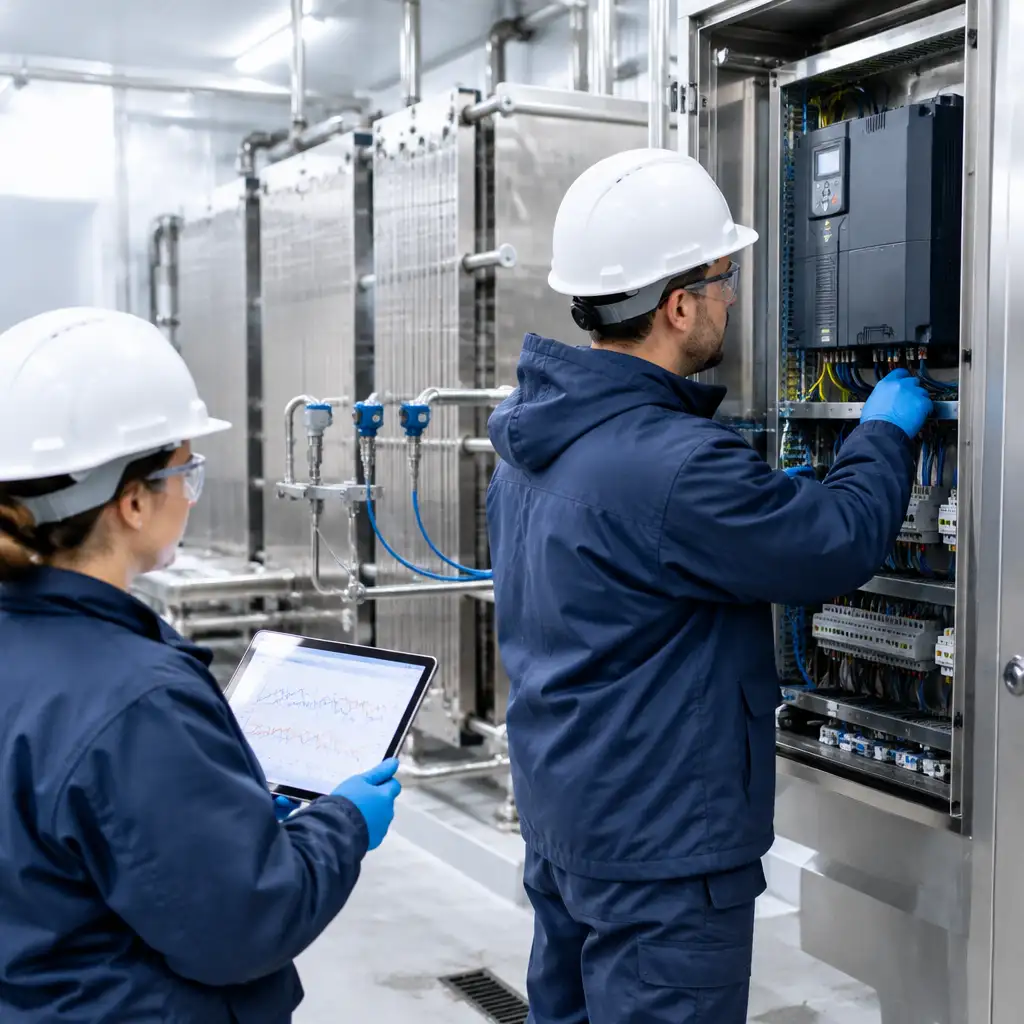
A plate freezer’s primary objective is uniform, repeatable freezing across product batches. Controls that manage refrigeration compressors, evaporators, expansion valves, conveyor indexing, and plate contact pressure play a critical role in cycle time and final product quality.
Common aging-control symptoms include erratic cycle times, inconsistent product core temperatures, frequent soft-stops or incomplete freezes, and alarms that are difficult to interpret. These symptoms often originate in the control and instrumentation layer even when compressors, plates, and hydraulics still function.
Modern plate freezer controls modernization can mean anything from replacing a handful of sensors and PLC I/O to a full modernization that integrates variable frequency drives (VFDs), advanced HMI/SCADA, and networked alarms. The right scope depends on plant goals, budget, and long-term lifecycle planning.
Early recognition of control-related performance degradation allows operations managers to plan upgrades rather than react to catastrophic failures that disrupt production and increase product loss.
Why It Matters
Unstable or slow freeze cycles directly affect throughput and yield. When core temperatures do not meet specification, product is reworked, downgraded, or discarded—each outcome reduces profit and adds operational complexity. Even small increases in cycle time add up over a production shift.
Control failures also create secondary costs: increased utility consumption from inefficient refrigeration staging, higher maintenance labour for manual interventions, and lost production during troubleshooting. For marine and shore-based seafood processors, reliability is especially critical because product windows are narrow and supply chain timing is tight.
Modern controls improve repeatability and reduce human error. Better logging and alarms support faster troubleshooting and can be integrated with preventive maintenance programs to reduce emergency repairs and unplanned downtime.
From an engineering perspective, investing in controls modernization often yields a faster return on investment than replacing mechanical refrigeration unless the existing compressors or heat exchangers are at end of life.
Common Causes or Industry Considerations
Several recurring causes point plant managers toward controls upgrades rather than other interventions:
- Obsolete PLC hardware or unsupported firmware that cannot be patched or integrated with modern HMIs.
- Degraded or uncalibrated RTD/thermocouple sensors producing noisy temperature readings and triggering premature or extended cycles.
- Poorly tuned PID loops controlling expansion valves or plate contact hydraulics, causing temperature oscillation and inconsistent freezing depth.
- Uncoordinated compressor staging and defrost schedules that create transient temperature spikes during shifts.
- Lack of integration with plant SCADA or MES for production tracking, making it hard to correlate freezing data with quality issues.
Industry considerations specific to seafood processing include saltwater contamination risk, rigorous sanitation cycles, and the need to maintain plate integrity. Controls must support CIP schedules, tolerate washdown environments, and minimise nuisance alarms during normal cleaning operations.
Regulatory and food-safety drivers also influence modernization choices—traceability and data logging requirements make modern HMI/SCADA with secure data storage an attractive feature.
Engineering or Operational Solutions
When evaluating upgrade paths, engineers typically consider two primary options: targeted retrofits and full-system replacements. Each has trade-offs in cost, downtime, and long-term benefits.
| Option | Typical Scope | Pros | Cons |
|---|---|---|---|
| Retrofit | Replace PLC CPU, upgrade I/O, add modern sensors, tune PID, integrate VFDs | Lower capital cost, shorter schedule, preserves useful mechanical equipment | May retain some legacy limitations; limited long-term scalability |
| Full Replacement | New refrigeration control architecture, HMI/SCADA, modern compressors/VFDs | Best long-term performance, full integration, easier support | Higher upfront cost, longer implementation, greater initial downtime |
Control strategies that stabilise product temperature and reduce cycle variance include:
- Closed-loop control of plate contact pressure and secondary coolant flow to maintain consistent thermal transfer.
- Multi-variable PID control that considers plate temperature, product core temperature, and conveyor speed for coordinated setpoint changes.
- Staged compressor control with load-based modulation using VFDs to avoid temperature overshoot and excessive cycling losses.
- Adaptive setpoint strategies that adjust freeze profiles based on incoming product temperature and batch size to optimise cycle time without sacrificing quality.
Sensors and instrumentation are critical: upgrading to robust RTDs or RTD arrays, adding high-accuracy product core probes, and ensuring sensor wiring and grounding are to industrial standards reduces noise and false trips.
Control system cybersecurity and network architecture are also considerations. Modern HMIs and remote monitoring should be deployed on segregated networks or via secure VPN to protect control integrity while enabling remote diagnostics.
Best Practices
Follow these practical steps when planning plate freezer controls modernization:
- Start with data: collect cycle time logs, freeze profiles, alarm histories, and energy usage to build a baseline for improvement.
- Perform a controls audit with an engineering partner to identify the weakest links—sensors, PLCs, drives, or networking.
- Prioritise upgrades that reduce variability: sensor replacement, PID retuning, and adding VFD control typically deliver measurable gains quickly.
- Plan for phased implementation to keep production running—retrofits can often be done one freezer line at a time.
- Integrate control upgrades with preventive maintenance to ensure mechanical systems (plates, hydraulic systems, compressors) are in good condition before commissioning new controls.
- Use standardised, documented control logic and operator interfaces to reduce operator error and simplify training.
Operational changes that complement controls modernization include training operators on new HMI features, updating SOPs to reflect automated freeze profiles, and scheduling regular calibration checks as part of preventive maintenance.
From an electrical perspective, ensure VFDs and soft starters are coordinated with motor protection devices and electrical distribution upgrades if increased motor loads are anticipated.
How NEMES Helps
NEMES combines engineering consultation, equipment sales, and field service to guide seafood processors through plate freezer controls modernization. Our approach begins with a site assessment to document refrigeration system status, controls architecture, and production goals.
We support customers with engineering consultation and equipment recommendations, helping you choose between a targeted retrofit or a full replacement based on lifecycle cost and performance objectives. Learn more about our equipment sales and specification assistance for industrial refrigeration systems.
For implementation, NEMES provides field service and preventive maintenance support—our technicians perform control panel wiring, PLC programming, sensor calibration, and commissioning work to bring systems to specification. We offer responsive technical service and troubleshooting services to minimise downtime during upgrades.
We also source components through our marine and industrial marine supply store and established manufacturer partnerships, ensuring replacement sensors, VFDs, and control hardware meet industrial quality expectations. For longer-term support or to discuss modernization planning, you can contact NEMES and request engineering assistance.
Expected Improvements: Throughput, Yield, and Lifecycle Cost
Quantifiable benefits from controls modernization typically include reduced cycle time variance, higher throughput, and improved yield. Typical outcomes processors report after a controls upgrade are:
- 5–15% reduction in average cycle time through better PID tuning and VFD-based refrigeration staging.
- Reduction in product rejects or rework by 20–50% due to tighter temperature control and reliable core-temperature verification.
- Lower energy costs from optimized compressor staging and reduced compressor short-cycling.
- Fewer emergency repairs and faster troubleshooting because of better alarms, logs, and remote diagnostics.
From a lifecycle cost perspective, retrofits often pay back within 12–36 months through improved throughput and lower energy and labour costs. Full replacements have higher initial capital but can extend system life and reduce total cost of ownership when mechanical refrigeration equipment is also at or near end-of-life.
Conclusion
Plate freezer controls modernization is a pragmatic investment for seafood processors seeking to reduce product loss, stabilise cycle times, and increase throughput. Whether a targeted retrofit or a full replacement is appropriate depends on your current refrigeration equipment condition, production goals, and long-term maintenance strategy.
Plant managers should prioritise data collection, controls audits, and an engineering partner who understands industrial refrigeration and marine processing environments. Thoughtful control upgrades—combined with improved sensors, VFD integration, and preventive maintenance—deliver measurable improvements in yield, energy use, and operational predictability.
For help evaluating upgrade options, selecting hardware, or planning phased implementations that keep production running, NEMES provides engineering consultation, equipment recommendations, parts sourcing, and field service tailored to industrial refrigeration and plate freezer systems.
Contact us to discuss options that meet your performance and budget objectives.
Frequently Asked Questions
How do I know if my plate freezer issue is controls-related?
If you see inconsistent cycle times, frequent false alarms, noisy temperature readings, or manual interventions to meet product spec, controls are likely a major contributor. A controls audit that reviews sensors, PLC logic, and drives can confirm the root cause.
Can a controls retrofit be done without replacing the refrigeration compressors?
Yes. Many controls improvements—sensor upgrades, PLC and HMI replacement, PID tuning, and adding VFDs for pumps—can be executed while retaining existing compressors, provided the mechanical equipment is in good condition.
What are typical downtime impacts during a controls upgrade?
Phased retrofits can often be performed with limited downtime by working on one freezer line at a time or during scheduled production gaps. Full replacements require more planning and may need short planned outages for commissioning.
How does modern control logic reduce product loss?
Modern logic coordinates refrigeration staging, plate contact, and conveyor speed with accurate, noise-free temperature data. This reduces temperature overshoot and underfreeze events that cause rejects or rework.
Should I prioritise sensor replacement or PLC replacement first?
Begin with data: if sensors are old or show inconsistent readings, replace or recalibrate them first. Reliable inputs often yield immediate improvements. If you still have integration or functionality limits, upgrade the PLC/HMI next.
Does NEMES support ongoing preventive maintenance after an upgrade?
Yes. Preventive maintenance and calibration programs extend the benefits of controls modernization by keeping sensors, electrical connections, and mechanical components in specification.
Selecting the right equipment is critical to long-term performance and reliability. If you’re evaluating new systems or replacing aging components, NEMES can help you identify solutions that fit your operational requirements. Call (800) 540-8893 or email info@nemesinc.com to speak with our experienced team.