This article helps facility and maintenance managers recognise when VFD selection for cold storage is appropriate, compare control strategies (across direct-on-line, soft starters, and VFDs), avoid common installation pitfalls, and estimate realistic energy and payback outcomes. Practical checklists and maintenance guidance are included to make selection and deployment more predictable.
Understanding the Challenge
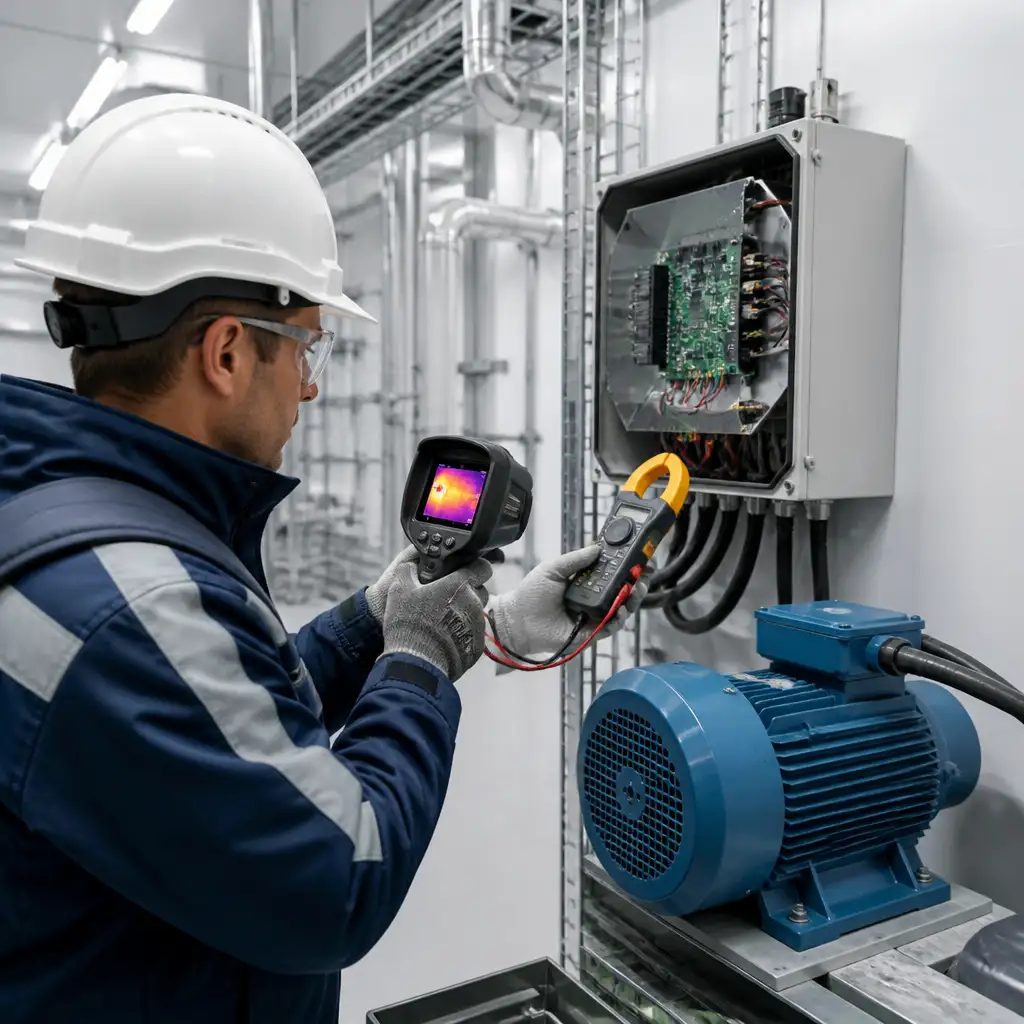
Cold storage operations use a variety of motor-driven devices: evaporator fans, condenser fans, glycol pumps, brine pumps, and compressor packages. Many of these loads have variable demand profiles—fan speed, pump flow, or compressor capacity—that are not optimally served by fixed-speed drives or basic soft-start devices.
Typical symptoms that indicate a motor-control upgrade may be needed include frequent starter or motor failures, high inrush-related nuisance trips, unstable temperature control, elevated energy consumption during low-load periods, and audible mechanical stress at startup. These symptoms often signal either a mismatch between control strategy and application or installation issues such as improper cable sizing or inadequate enclosure cooling.
If you need help documenting operating profiles before specification, NEMES provides engineering assistance for load analysis and equipment selection to support informed decisions about VFD selection for cold storage and related upgrades. See our equipment selection and engineering consultation services at equipment selection.
Why It Matters
Choosing the correct motor-control approach impacts three measurable outcomes: energy consumption, equipment reliability, and lifecycle cost. For variable loads, VFDs adjust motor speed to match demand rather than cycling power on and off or using throttling devices. Because fan and pump power follows the cube (or near-cube) relationship to speed, modest speed reductions can yield large energy savings.
Beyond energy, soft-start failures and repeated starter stress shorten motor life and increase repair costs. A VFD offers controlled acceleration, torque management, and fault diagnostics, reducing mechanical stress on couplings, belts, and impellers. Over time this improves uptime and lowers maintenance expenditures.
Finally, lifecycle cost includes initial equipment, installation, commissioning, spares, and long-term support. Well-specified VFD systems can reduce lifecycle cost through energy savings, fewer downtime incidents, and remote monitoring capabilities that support preventive maintenance programs.
Common Causes or Industry Considerations
Several practical factors influence whether a VFD is the right choice for a particular motor or system in cold storage.
- Load variability: Fans and pumps with frequent partial-load operation are ideal candidates for VFDs. Compressors or motors that run near full load continuously may deliver less dramatic ROI.
- Motor rating and duty cycle: Motors must be correctly sized; undersized motors run hot when throttled, while oversized motors may run inefficiently. Verify motor shaft loading and duty cycle before retrofitting a drive.
- Ambient conditions: Cold rooms and mechanical rooms present condensation and low-temperature challenges; VFD enclosures, heaters, and appropriate IP ratings are necessary.
- Electrical infrastructure: Harmonics, long motor cable runs, and shared neutrals can cause interference with other systems unless mitigated with filters, dV/dt-rated cables, and grounding practices.
- Control integration: Coordinate VFD control with building automation, refrigeration controls, and safety interlocks to avoid control conflicts that could harm system stability.
Engineering or Operational Solutions
Compare the principal motor-control strategies and how each addresses energy, soft-start failures, and lifecycle costs. The table below summarises typical performance and application guidance for direct-on-line (DOL), soft starters, and VFDs.
| Control Strategy | Energy Impact | Soft‑Start Failures | Lifecycle Cost & Best Use |
|---|---|---|---|
| Direct‑On‑Line (DOL) | No speed control; full power at start | High inrush can cause mechanical stress and starter wear | Lowest capital cost; best for constant full‑load motors |
| Soft Starter | Reduces starting torque and inrush but no continuous speed control | Reduces soft‑start failures vs DOL, but thermal stress can persist over cycles | Mid cost; good for reducing mechanical shock where speed control is not needed |
| VFD | Enables continuous speed control; large energy savings on variable loads | Controlled acceleration and torque; reduces start/stop wear significantly | Higher initial cost but lower lifecycle cost for variable loads; best for fans, pumps, and modulating compressors |
In many cold storage facilities a hybrid approach is appropriate: retain DOL for purely constant, low‑duty loads; use soft starters where simple torque limiting reduces mechanical shock; and deploy VFDs on fans, pumps, and compressor drives where speed control produces measurable savings and reliability gains.
Motor and VFD Selection Checklist
- Confirm actual motor horsepower, service factor, and nameplate data.
- Document operating duty cycle: run hours at full, partial, and idle conditions.
- Evaluate load type: centrifugal (fan/pump) vs positive displacement (compressor).
- Check motor insulation class and ambient temperature rating; consider heaters for condensation mitigation.
- Specify VFD with appropriate overload capacity, carrier frequency options, and IP rating for the environment.
- Plan for harmonic mitigation (filters or multi‑pulse drives) if multiple VFDs will be installed on the same supply.
- Design cable runs for reflected-wave mitigation: use dV/dt‑rated cables and consider output reactors for long runs.
- Include bypass or manual-start provision for serviceability and emergency operation.
- Confirm control integration requirements with refrigeration controls and building automation systems.
- Account for service access, spare parts, and firmware support from the manufacturer or supplier.
Typical Payback Scenarios and Energy Benefits
Payback depends on application, load profile, and electricity cost. Typical conservative estimates:
- Evaporator and condenser fans: speed control often reduces energy use by 30–60% when average operating speed is significantly below nameplate. Payback: commonly 1–3 years in facilities with long run hours.
- Circulation pumps (glycol/brine): on variable flow systems, VFDs can cut pump energy 20–50% depending on throttling avoided. Payback: 2–4 years.
- Compressor drives: VFDs on compressors provide capacity matching and reduced cycling; savings vary widely. Payback can be 2–6 years depending on system design and refrigerant type.
These ranges assume proper commissioning, minimal installation complications, and accurate load profiling. Where operational hours are lower or mechanical systems are already optimised, payback will lengthen. NEMES can help model site‑specific payback using measured operating data; see our engineering consultation and field service capabilities for assistance with on‑site audits.
Best Practices
To secure the expected energy and reliability benefits from VFD selection for cold storage, follow proven best practices during specification, installation, and commissioning.
- Conduct a site survey and measure existing operating profiles rather than basing decisions solely on nameplate ratings.
- Specify VFDs and motors together: ensure motor insulation and bearing protection are compatible with inverter output.
- Plan for harmonic analysis and mitigation when multiple drives are installed; include passive or active filters where required.
- Design cable routing with separation between power and control wiring, and include proper grounding and surge protection.
- Provide adequate cooling for VFD enclosures, and consider ambient heaters in cold rooms to prevent condensation.
- Include acceptance testing and commissioning protocols: verify ramp times, torque limits, EMC performance, and interlocks with refrigeration controls.
- Develop a preventive maintenance schedule for VFDs that includes fan and filter cleaning, capacitor health checks, firmware updates, and log review.
How NEMES Helps
NEMES combines engineering-led consultation, equipment sales, and responsive field service to guide facility managers through VFD selection for cold storage and full system upgrades. Our services are designed to reduce installation risk and ensure long-term performance:
- Engineering consultation and system design assistance to match VFD specification to actual load characteristics and refrigeration controls.
- Equipment recommendations and sourcing from industry-leading suppliers, backed by our longstanding manufacturer partnerships.
- On-site field service for installation support, commissioning, and troubleshooting, including harmonic and EMC mitigation measures.
- Preventive maintenance plans and emergency repairs to minimise downtime and extend lifecycle value for motors and drives.
Where projects require parts or urgent replacement components, our marine and industrial supply store stocks common motors, VFD accessories, and electrical components to shorten lead times. For installations that require coordination with refrigeration controls or automation systems, NEMES provides specification and integration support through our equipment sales and engineering teams.
Conclusion
VFD selection for cold storage is an effective way to reduce energy use, reduce soft‑start failures, and lower lifecycle costs—provided the decision is based on accurate load profiling, appropriate motor and VFD specification, and careful installation. Facility managers should watch for repeated starter failures, unstable temperature control, and high partial‑load energy consumption as signs that a VFD or improved control strategy may yield measurable returns.
Prioritise a structured approach: measure operating profiles, use the motor/VFD selection checklist, plan for electrical and environmental constraints, and commission the system with a qualified team. When combined with preventive maintenance and proper integration with refrigeration controls, VFDs deliver both energy and reliability benefits that justify their initial cost in many cold storage applications.
If you’re evaluating options or need on‑site assessment and payback modelling, please contact NEMES to request engineering support and local service coordination.
Frequently Asked Questions
1. How do I know if a VFD will pay back for my evaporator fans?
Estimate actual operating hours and average speed reduction. If fans regularly run at partial speed and total annual run hours are high, expect 30–60% potential energy savings and typical payback in 1–3 years. A site audit gives a more accurate projection.
2. Can I retrofit a VFD to any existing motor?
Many motors can accept VFDs, but verify insulation class, bearing protection, and ambient conditions. Older motors or those with marginal insulation may require replacement or additional protection before a VFD retrofit.
3. What common installation mistakes cause VFD failures?
Frequent issues include long motor cable runs without proper dV/dt mitigation, inadequate enclosure cooling, poor grounding, and lack of harmonic filtering when multiple drives share a supply. Proper installation and commissioning reduce these risks.
4. How do VFDs reduce soft‑start failures compared with soft starters?
VFDs provide full speed control and torque management across the operating range, reducing the number of start/stop cycles and mechanical stress. Soft starters only limit inrush during acceleration and do not provide efficient speed control during run periods.
5. Are there special considerations for cold room installations?
Yes. Cold rooms may cause condensation in electronic enclosures. Use IP‑rated VFDs, enclosure heaters, and ensure ambient-rated components. Also consider placement outside the cold room where practical, with appropriate cable routing and insulation.
6. What maintenance should be included for VFDs?
Regular visual inspections, fan and filter cleaning, capacitor checks, firmware updates, and logfile reviews. Include VFD checks in your preventive maintenance program to catch cooling or ventilation issues early.
Selecting the right equipment is critical to long-term performance and reliability. If you’re evaluating new systems or replacing aging components, NEMES can help you identify solutions that fit your operational requirements. Call (800) 540-8893 or email info@nemesinc.com to speak with our experienced team.