The intent is practical: help plant and fleet managers, maintenance and procurement teams, marine engineers, and refrigeration contractors make defensible choices that reduce spoilage and downtime. For projects that require detailed load calculations or on-site layouts, consider an equipment selection or engineering consultation to translate operational targets into a complete system spec.
Understanding the challenge
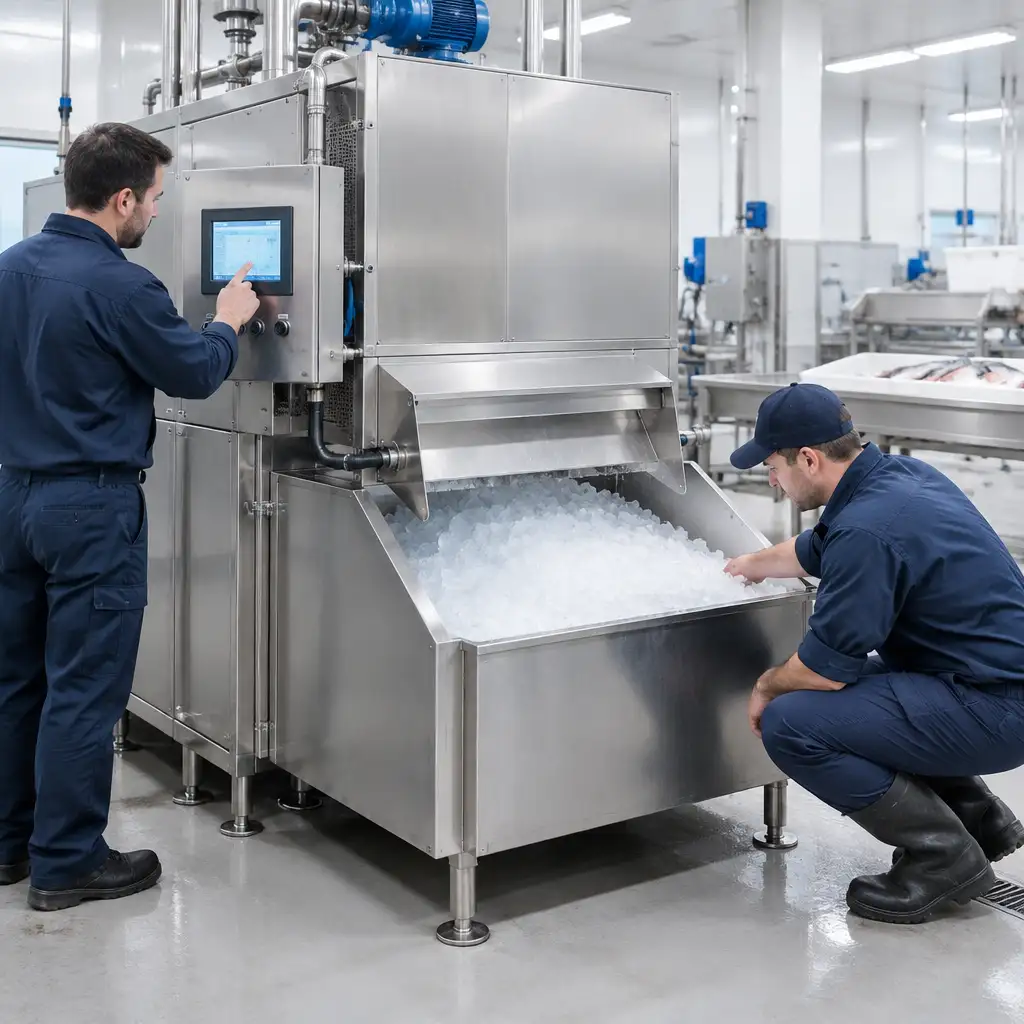
Seafood operations use ice in several distinct scenarios: onboard catch cooling immediately after harvest, landing and short-term storage on dock or truck, processing-line chilling (bleeding, brining, glazing), refrigerated sea water (RSW) and brine treatment, and glazing for frozen product. Each scenario has different priorities for contact area, melt rate, salt content, and mechanical handling.
Key decision criteria operators face include cooling rate (how quickly product must reach target temperature), whether ice must be pumped or handled by gravity, melt characteristics (affecting brine concentration and drip loss), abrasion and fragility (important for delicate species), sanitation and washdown needs, footprint and mobility constraints, and how the ice system will integrate with existing refrigeration and controls.
Example — vessel vs plant: a small inshore vessel prioritises compact equipment, rapid catch icing, and minimal power draw; a shore‑based processing plant may prioritise continuous high‑capacity production, automated pumping for glazing, and large insulated bins. These contrasting needs drive very different equipment choices and layouts.
Why it matters
Choosing the right ice type and equipment affects multiple business outcomes. Rapid, even cooling preserves flesh quality and reduces bacterial growth; inadequate cooling accelerates spoilage and can force downgrades at sale. Ice system reliability impacts throughput—stops in ice production or feed delays can bottleneck processing lines and increase labor costs.
Sanitation and regulatory compliance also depend on system design. Ice is a direct contact cooling medium; poor water quality, improper salt management, or contaminated storage surfaces create food‑safety risks. Energy efficiency and lifecycle considerations—initial capital versus operating costs—also influence selection: higher upfront cost equipment can be justified by lower downtime and maintenance over a decade of service.
Common causes or industry considerations
Typical failure points and operational problems observed in the field include undersized production relative to peak throughput, storage bin bridging that prevents reliable discharge, improper pump selection for slurry or granular systems, and excessive corrosion or abrasion in piping and fittings. Controls can be a weak link when systems are retrofitted without proper sequencing or protective interlocks.
Other recurring issues are inadequate sanitation access for bins and conveyors, poor spare parts planning (leading to long outages when a unique seal or rotor fails), and lack of integration between ice controls and plant PLCs or motor controls. On vessels, power limitations and space constraints commonly lead to compromises that reduce performance.
Engineering or operational solutions
Below is a concise comparison table followed by detailed guidance on equipment selection, pumps, controls, and qualitative sizing guidance.
| Ice Type | Best Applications | Pros / Cons | Storage Options | Melt Behavior | Approx. Capacity Band | Pumping Needs |
|---|---|---|---|---|---|---|
| Flake ice | Bleeding, processing lines, icing bins, glazing | High contact area, gentle on product; requires dry production water; equipment moderate footprint | Insulated bins with gravity feed; conveyors | Fast melt due to large surface area; useful for rapid cooling | Small→Large (plant lines to large plants) | Typically gravity for bin discharge; conveyors or augers for transport; pumps not required for dry flake |
| Slurry ice | Onboard catch cooling, transport, continuous glazing, RSW / brine replacement | Excellent heat transfer; pumpable; mixes water and micro‑ice; requires corrosion‑resistant components and conductivity control | Insulated tanks with recirculation loop | Very low melt in transport due to micro‑ice suspension; creates saline cooling if using brine | Medium→Large (fleet systems to large plants) | Requires centrifugal or progressing cavity pumps sized for solid fraction; VFD recommended |
| Crushed / granular ice | Short‑term catch icing, box icing for transport, glazing | Flexible, easy to handle; variable particle size; can compact and bridge if mishandled | Insulated bins, hopper feeders | Moderate melt; compacts under load | Small→Medium | Usually gravity discharge; augers or vibratory feeders common; pumps not typical |
| Block ice | Long‑term cold storage, large transport, specialty applications | High mass and slow melt; labor intensive to handle and break | Large insulated rooms or pallets | Slow melt; stable thermal mass | Medium→Large | Usually no pumping; mechanical handling required |
| Granular (nugget) ice | Retail icing, product display, small glazing | Good adherence and low abrasion; lower cooling per volume than flake | Small bins, hoppers | Moderate melt; clumps less than crushed | Small | Gravity/auger; pumps uncommon |
Equipment selection notes
- Production technologies: mechanical ice makers (for flake/granular/crushed), slurry generators (vessel or plant scale), and brine chillers for RSW integrations. Consider match between refrigeration plant capacity and ice maker thermal load.
- Pumps: slurry and RSW systems need pumps that tolerate ice slurry—progressing cavity pumps or chilled‑slurry rated centrifugal pumps with gentle handling are common. Select construction materials for corrosion resistance (316 stainless, duplex where needed) and ensure seals are compatible with saline fluids.
- Controls and instrumentation: use conductivity and salinity sensors for slurry/brine systems, level switches for bins and tanks, flow meters for pump monitoring, and PLC integration for sequencing. VFDs or soft starters reduce mechanical stress on pumps and are recommended for repeatable start/stop cycles.
- Piping and heat exchangers: minimize exposed runs for slurry; prefer short, insulated piping and large‑radius bends. Plate or shell‑and‑tube exchangers used for chiller integration must be selected to avoid clogging by ice crystals—reliable filtration and recirculation piping design are essential.
- Modular vs prefab: prefabricated skid systems speed installation and standardize controls; custom systems may be required where space or power constraints exist (e.g., small vessels).
Sizing guidance (rules of thumb)
Translate product throughput and target cooling time into ice production by estimating the heat to be removed (product mass × temperature drop) and then mapping that qualitative load into an ice‑throughput band. Use the following pragmatic rules of thumb until a site‑specific calculation is performed:
- Small on‑board systems (catch up to a few tonnes per day): target a compact slurry unit or small flake machine. Prioritise pumpable slurry for rapid onboard circulation and short target cooling times.
- Medium processing lines (single processing line up to several tonnes per hour): flake ice makers with 1–3 m3 insulated bins and reliable gravity/auger feed are common. Allow storage for at least one shift of peak production plus contingency.
- Large plants (multiple lines / glazing operations): continuous slurry or high‑capacity flake systems with redundant production and large insulated tanks/bins. Provide recirculation and multiple discharge points to avoid bottlenecks.
When to engage engineering consultation: if your operation expects tight cooling windows (minutes to reach target), integration with blast/freezers, long slurry piping runs, or unusual space/power constraints, request a site‑specific load and layout calculation from an engineering firm such as NEMES to determine exact ice capacity, refrigeration sizing, and pump selection.
Best practices
Installation and layout
Locate ice production as close as practical to the largest use points to reduce heat gain in transfer lines and to simplify controls. For gravity systems use vertical lifts and short conveyors; for slurry loops design for pumped recirculation with minimal exposed piping and large‑radius turns.
Storage and bin design
- Design bins to avoid bridging: use steep hopper angles, liner surfaces with low friction, and internal agitation or vibrators for problematic materials.
- For slurry, provide recirculation and mild agitation to keep crystals suspended and to prevent stratification. Insulate tanks and include level and temperature sensors at multiple heights.
- Drainage and sloped floors beneath bins reduce standing water and help sanitation.
Sanitation and washdown
- Specify food‑grade materials (stainless steel 316 where salt exposure is expected) and hygienic fittings. Avoid crevices and dead legs in bins and piping.
- Design for clean‑in‑place (CIP) where feasible; include washdown access and ensure electrical equipment is IP‑rated for wash environments.
- Monitor water quality for generators and prevent biofilm formation with regular CIP and water treatment.
Preventive maintenance and spare parts
- Stock wear items: pump seals, rotors, impellers, bearings, V‑belts, and common control relays/instrumentation modules.
- Prioritise preventive checks on pumps (seal condition, shaft runout), heat exchangers (fouling), and control calibration (level, conductivity sensors).
- Keep vendor contact and part numbers accessible and coordinate with a supplier for prioritized parts sourcing.
Operational checks and monitoring
- Record production vs demand to identify capacity shortfalls; track melt rates in bins and storage temperature trends.
- Monitor pump flow, motor current, and vibration to detect early wear; use VFD logs to understand cycling behaviour.
- For saline systems monitor conductivity and salinity to protect product quality and prevent excessive corrosion.
How NEMES Helps
NEMES provides engineering‑led support across the full lifecycle of industrial ice systems. We deliver engineering consultation and system design assistance to align ice capacity with product throughput and cooling‑time targets; help specify appropriate ice machines, slurry generators, pumps, motors, and controls; and support procurement and installation planning.
Our services extend to equipment sales and product sourcing through partnerships with trusted manufacturers, plus stocking of common replacement components in our marine & industrial supply store. For customers who need on‑site work, NEMES offers field service, commissioning, and troubleshooting to get systems operational and optimised.
Practical examples of assistance we provide:
- Siting and system layout reviews to minimise piping losses and simplify controls.
- Pump and motor selection, including materials recommendations for saline/slurry service and VFD integration to protect equipment life.
- Controls integration advice—PLCs, level and conductivity sensors, and automated sequencing for reliable production.
- Spare‑parts sourcing and stocking plans to reduce downtime risk, and preventive maintenance program development that focuses on wear parts and sanitation intervals.
For operations that already have equipment, NEMES can evaluate existing performance and recommend upgrades or replacements that reduce lifecycle costs and improve uptime. Our integrated approach combines engineering, equipment sales, supply, and field service so teams have a single technical partner for complex ice system projects.
To discuss field service or preventive maintenance services for your ice system, NEMES can review common failure modes and help prioritise upgrades that improve reliability and reduce total cost of ownership.
Frequently Asked Questions
Which ice type is best for onboard catch?
For most vessels, slurry ice offers the best combination of rapid cooling, pumpability, and reduced melt during transport. Small boats may prefer compact flake makers if power is limited. Engage engineering review when space, weight, or shore power limits are a concern.
How much ice do I need per ton of fish?
Ice required depends on target temperature, starting fish temperature, and cooling time. Use the mass of product and desired temperature drop as the input to a site‑specific calculation. As a planning rule of thumb, size production to meet peak hourly throughput with storage for at least one shift plus safety margin, and contact NEMES for a detailed load calculation.
Can slurry be pumped long distances?
Slurry can be pumped effectively, but long runs increase head loss and heat gain. Keep runs short, use insulated pipe with large diameter and gentle bends, and select pumps rated for slurry. For runs that exceed practical lengths, consider distributed production or refrigerated transfer methods.
What sanitary materials are recommended?
Use stainless steel (316) for tanks and wetted piping where salt exposure occurs. Use food‑grade seals and hygienic fittings. Design for CIP access and washdown while protecting electrical equipment with appropriate IP ratings.
How do I prevent bin bridging?
Design bins with steep hopper angles, smooth liners, internal agitation or vibrators if necessary, and consider live‑bottom augers. For problematic ice types, recirculation or staged discharge points can reduce compaction.
Conclusion
Choosing the right ice type, production technology, and storage layout is an engineering decision with direct operational and financial impact. Operators should balance cooling performance, handling, sanitation, and lifecycle costs when selecting flake, slurry, crushed, or block systems. Use the sizing rules of thumb in this guide to scope options, then engage an engineering review for site‑specific thermal loads, pump selection, and layout optimisation.
To evaluate options for your vessel or plant and develop a practical specification that minimises spoilage and downtime, please contact NEMES to request technical assistance.
Industrial facilities rely on dependable equipment to maintain production and minimize downtime. NEMES works with manufacturers, processors, and industrial operations to provide engineering support, equipment recommendations, technical products, and ongoing service. Call (800) 540-8893 or email info@nemesinc.com to discuss your operation.