Understanding the Challenge
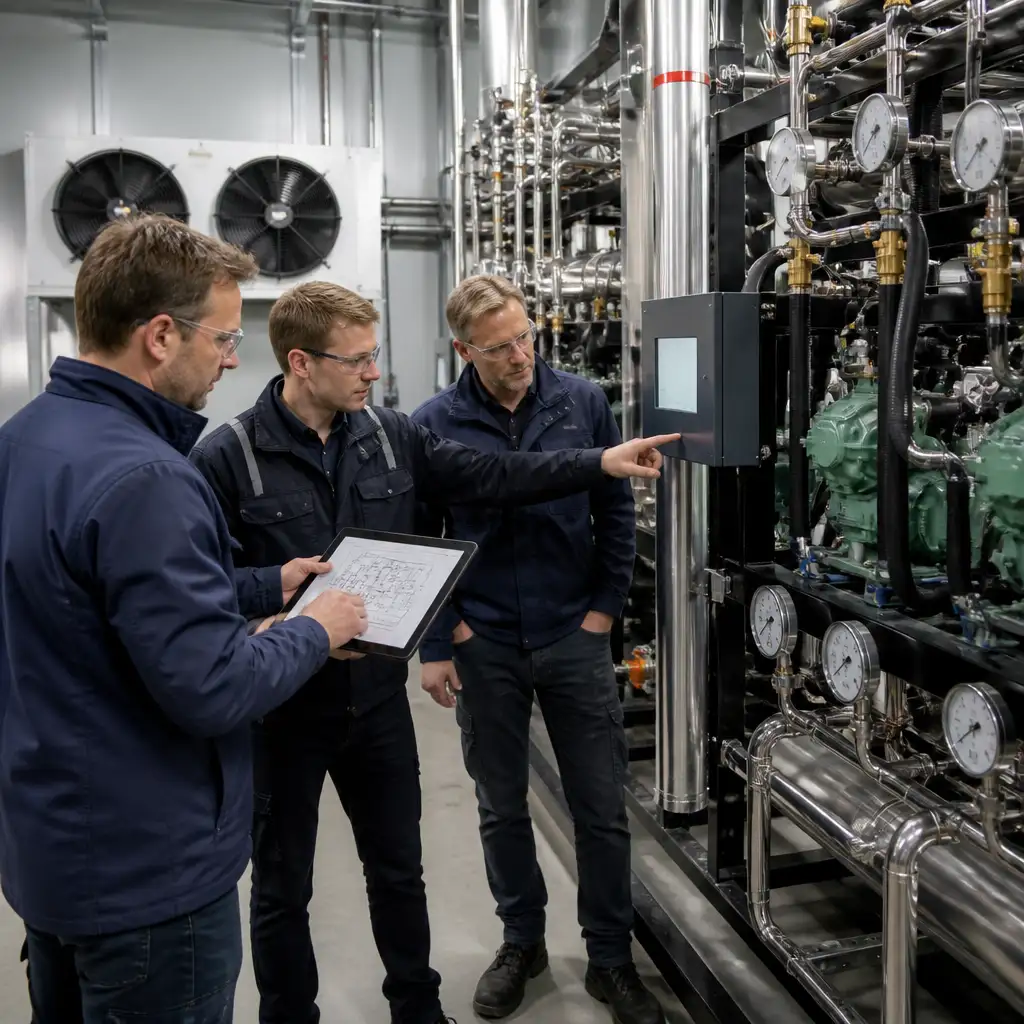
Many supermarkets still operate systems designed around legacy refrigerants and components that are now inefficient and expensive to maintain. Common symptoms include frequent compressor trips, refrigerant leaks, poor temperature stability in display cases, and sharply rising electricity consumption. As equipment ages, parts become harder to source and preventive maintenance becomes more critical — but also more costly.
When failure becomes imminent, managers must decide whether to pursue a like-for-like replacement, partial upgrades (compressors/controls), or a full CO2 refrigeration retrofit. Each option has different capital, operational, and safety implications. Early involvement of engineering expertise and coordinated planning reduces downtime and prevents costly scope creep.
For sourcing replacement components or system engineering support, facility teams often rely on experienced partners for equipment recommendations and procurement. Consider starting conversations early with an engineering-led supplier to evaluate retrofits vs. phased upgrades and to identify available manufacturer solutions.
equipment recommendations can clarify trade-offs between short-term repairs and long-term modernization.
Why It Matters
Refrigeration typically accounts for 40–60% of a supermarket’s energy consumption. Inefficiencies in compressors, heat exchangers, and controls directly drive utility costs. Modern CO2 systems also offer environmental benefits by eliminating high-GWP refrigerants, helping facilities meet regulatory pressure and corporate sustainability goals.
Reliability affects more than energy: product safety, shrink, and customer experience are at stake if case temperatures wander or if a compressor failure forces bulk product to be discarded. Planned modernization reduces emergency service calls, which are expensive and disruptive.
Finally, capital decisions should be considered in lifecycle terms. While a full CO2 retrofit involves higher up-front engineering and installation costs compared with isolated repairs, projected lifecycle savings from improved efficiency, lower refrigerant costs, and reduced downtime frequently justify the investment.
Common Causes and Industry Considerations
Before choosing a retrofit path, identify the root causes of poor performance. Typical issues include:
- Age-related equipment wear (compressors, valves, motors)
- Refrigerant leakage and increasing top-up requirements
- Obsolete controls and poor case-control strategies
- Undersized or fouled heat exchangers and condensers
- Inefficient oil management, leading to compressor stress
- Inadequate preventive maintenance history
Regulatory and market trends also influence decisions. Phasing down high-GWP refrigerants and stricter leak reporting can increase operating costs for HFC systems. CO2 (R-744) is a natural refrigerant with negligible GWP, but designs differ by climate and load profile — a factor that should inform the retrofit selection.
Engineering and Operational Solutions
Three common retrofit paths for supermarkets are: partial component replacement and controls upgrade, CO2 cascade retrofit, and CO2 transcritical (direct) systems. Below is a comparative overview to clarify trade-offs.
| Retrofit Scenario | Typical Capital Cost | Energy Efficiency | Reliability & Maintenance | Safety & Regulatory | Estimated Payback (years) | Notes on Lifecycle Savings |
|—|—:|—:|—|—|—:|—|
| Partial retrofit (compressors + controls) | Low–Moderate | Small improvement (5–15%) | Lower immediate risk; limited long-term benefit | Minimal changes | 2–6 | Lower near-term spend; may extend life 3–7 years depending on remaining assets |
| CO₂ cascade (secondary CO₂ loop with low-charge transcritical or booster HFC cascade) | Moderate–High | Moderate improvement (10–25%) | High reliability when engineered properly; moderate maintenance | Requires CO₂ safety planning but lower high-pressure charge in occupied spaces | 4–10 | Good lifecycle savings in mixed climates; reduced refrigerant cost exposure |
| CO₂ transcritical (direct system with parallel compression/ejectors/controls) | High | Variable; 0–25% (higher in cool climates; optimized in all climates with gas cooler control) | Modern systems engineered for supermarket loads are reliable; requires skilled service | High-pressure design; strict safety and commissioning needed | 5–12 | Best long-term environmental profile; lifecycle savings depend on climate and control strategies |
Notes: The energy efficiency estimates above are illustrative; real savings depend on store size, load diversity, local climate, and control sophistication. For many supermarkets in northern climates, CO2 transcritical and cascade options outperform legacy systems year-round. In warmer climates, additional measures (parallel compression, ejectors, two-stage compressors, or mechanical subcooling) improve transcritical performance.
Key engineering considerations when planning a CO2 refrigeration retrofit:
- System Charge and Layout: CO2 operates at much higher pressures than HFCs; designs must manage charge location (machine room vs. case-level), piping layout, and low-charge secondary loops to limit CO2 in occupied spaces.
- Compressor Selection: Modern open-drive or semi-hermetic CO2 compressors with variable speed drives provide load-matching and efficiency. Consider manufacturers that offer parallel compression or dedicated low-stage compressors for transcritical operation.
- Controls and Automation: Advanced PLC/BDD controls, case-level sensors, and energy-optimizing algorithms (digital control of gas cooler, suction pressure control, and pump staging) can deliver major savings and improved temperature stability.
- Heat Rejection Strategy: Gas coolers for transcritical systems must be sized and controlled for ambient conditions. Evaporative gas coolers or hybrid systems may be needed in hot climates.
- Oil Management and Suction Drains: Proper oil return and separator sizing are essential in CO2 systems to protect compressors and maintain reliability.
- Maintenance and Serviceability: Design for accessible service points, clear instrumentation, and compatibility with local service providers trained on CO2 systems.
Best Practices
To maximize the benefit of any retrofit, apply these best practices during planning and execution:
- Perform a full system audit that quantifies current kW loads by circuit, case, and refrigeration plant. Use measured data when possible rather than relying on nameplate ratings.
- Evaluate phased upgrades where practical: upgrade controls and case electronics first to capture immediate savings while planning a full CO2 retrofit.
- Design for serviceability: centralized machine rooms, clear shutoff valves, sight glasses, and easy access to compressors and controls reduce downtime and service costs.
- Invest in modern controls and case-management strategies (e.g., floating suction, adaptive defrost, case light and anti-sweat control) to reduce energy independently of the refrigerant choice.
- Train in-house maintenance staff and contract preventive maintenance with experienced field service providers to shorten mean time to repair and reduce emergency interventions.
- Plan for commissioning and third-party performance testing to validate design assumptions and identify tuning opportunities after startup.
Routine preventive maintenance is especially important after a retrofit while control strategies and tuning are validated. Consider service agreements that include seasonal tuning and emergency support to protect your investment.
For preventive care and field expertise, explore professional preventive maintenance and technical service offerings that specialize in commercial refrigeration systems.
How NEMES Helps
NEMES combines engineering consultation, equipment sales, and field service capability to support supermarket refrigeration projects from evaluation through long-term support. Our approach focuses on practical solutions tailored to operational needs and lifecycle cost reduction.
- Engineering consultation and system analysis: We assess existing loads, identify failure points, and model retrofit scenarios so you can compare costs and projected energy savings.
- Equipment selection and procurement: Through our equipment sales capability and relationships with trusted manufacturers, we recommend compressors, gas coolers, heat exchangers, and control platforms that suit CO₂ retrofits and modernization projects.
- Supply and parts: Our marine and industrial supply store stocks many replacement components, and we can source specialized parts through long-standing manufacturer partnerships.
- Field service and preventive maintenance: Our technicians provide on-site commissioning, seasonal tuning, troubleshooting services, and preventive maintenance plans to sustain efficiency and reliability after a retrofit.
Working with an engineering-led partner helps avoid common pitfalls in CO₂ system design and installation, such as improper charge management, insufficient gas cooler capacity, or poorly tuned control logic. NEMES’ integrated service model supports long-term performance and responsive emergency support when issues arise.
Projected Lifecycle Savings and Illustrative Estimates
Estimating lifecycle savings requires store-specific data, but the following illustrative example highlights potential benefits for decision-making:
- Baseline: A 20,000 ft² supermarket with an existing HFC system consuming 3,000,000 kWh/year for refrigeration and associated compressors/condensers.
- Partial retrofit estimate: 5–10% energy reduction → 150,000–300,000 kWh/year saved.
- CO₂ cascade or transcritical optimized: 10–25% energy reduction → 300,000–750,000 kWh/year saved.
At $0.12/kWh, the annual cost savings would range approximately from $18,000 (partial) up to $90,000 (optimized CO₂). Over a 10–15 year lifecycle, these reductions, combined with lower refrigerant replacement costs and fewer emergency repairs, can materially improve the total cost of ownership. Real projects should include detailed life-cycle cost modeling that accounts for capital investment, financing, maintenance, and energy price escalation.
For tailored estimates, engineering assistance can convert your utility bills and measured load profiles into accurate lifecycle projections and payback analyses.
Regulatory and Safety Considerations
CO₂ is non-flammable and has negligible GWP, but it is an asphyxiant and operates at high pressure. Compliance and safety planning are essential and should include:
- Risk assessments to determine allowable CO₂ charge locations and whether a low-charge/secondary loop is required in retail areas.
- Pressure-rated piping and components, appropriately certified and installed by qualified technicians.
- Leak detection and ventilation strategies in machine rooms and enclosed spaces.
- Emergency procedures and staff training for CO₂ detection and response.
- Adherence to local codes, ASHRAE guidelines, and manufacturer installation requirements.
Coordination with local authorities, experienced contractors, and an engineering partner helps ensure the retrofit meets regulatory expectations and that safety is integrated into system design.
Conclusion
When aging refrigeration begins to drive up operating costs and risk, supermarket managers should evaluate CO₂ refrigeration retrofit options as a long-term strategy to reduce energy, improve reliability, and align with environmental goals. Whether choosing a phased component upgrade, a CO₂ cascade, or a full transcritical system, careful engineering, the right compressor and control selection, and a robust maintenance strategy determine success.
Early engineering engagement, accurate load measurement, and partnership with experienced equipment suppliers and field-service teams reduce execution risk and improve lifecycle outcomes. Structured planning also minimizes operational disruption and helps ensure the retrofit meets safety and regulatory obligations.
If you’re considering a CO₂ refrigeration retrofit or need to evaluate your existing refrigeration assets, talk to qualified engineering professionals to quantify options and build a plan that fits your operational needs.
contact NEMES to discuss project scoping, equipment selection, or service support for refrigeration modernization.
Frequently Asked Questions
1. What is a CO₂ refrigeration retrofit and why choose it?
A CO₂ refrigeration retrofit replaces or reconfigures existing refrigerant circuits to use CO₂ (R‑744). Facilities choose CO₂ for its low global warming potential, potential energy savings with modern controls, and reduced exposure to phasedown regulations for HFCs.
2. How much can I realistically save on energy?
Savings vary by climate, store load, and system design. Typical ranges are 5–15% for partial upgrades and 10–25% for well-engineered CO₂ systems. Detailed monitoring and modeling produce reliable estimates for each site.
3. Are CO₂ systems safe in retail environments?
Yes — when designed and installed correctly. Safety measures include limiting CO₂ charge in occupied spaces, properly rated piping and equipment, leak detection, ventilation, and staff training. Engineering risk assessments determine required safeguards.
4. Can we phase a retrofit to spread costs?
Phased approaches are common: upgrading controls and critical compressors first, then implementing a CO₂ circuit later. Phasing can reduce disruption but requires careful planning to ensure compatibility between old and new systems.
5. What role do controls play in CO₂ performance?
Controls are critical. Optimized gas cooler management, suction pressure control, variable-speed drives, and coordinated case control can significantly influence transcritical system efficiency and temperature stability.
6. How do I start evaluating a retrofit for my store?
Begin with a system audit that collects operating data, refrigerant inventories, and failure history. Use that information to compare scenarios (partial upgrade, cascade, transcritical) with lifecycle cost modeling. Engage engineering support early to scope options and estimate payback.
[CTA 2 — Equipment Selection]
Selecting the right equipment is critical to long-term performance and reliability. If you’re evaluating new systems or replacing aging components, NEMES can help you identify solutions that fit your operational requirements. Call (800) 540-8893 or email info@nemesinc.com to speak with our experienced team.