Pump redundancy design is a core reliability strategy for industrial and marine facilities that depend on continuous fluid handling. Plant and industrial engineers must balance capital cost, operational complexity, and maintainability while ensuring systems can survive component failures without causing unplanned downtime. This guide breaks down practical engineering approaches—N+1 architectures, parallel duty/standby arrangements, isolation and bypass design, control logic, VFD and soft starter integration, monitoring strategies, and spare-parts planning—to help you make informed decisions for systems ranging from refrigeration circulation to process transfer and seawater systems.
Throughout the article we reference practical engineering choices, compare common redundancy architectures, and highlight factors that influence lifecycle costs. Where appropriate, links point to NEMES resources for equipment selection and field support so you can source pumps, drives, and controls that meet the needs of marine, commercial, and industrial applications.
Understanding the Challenge
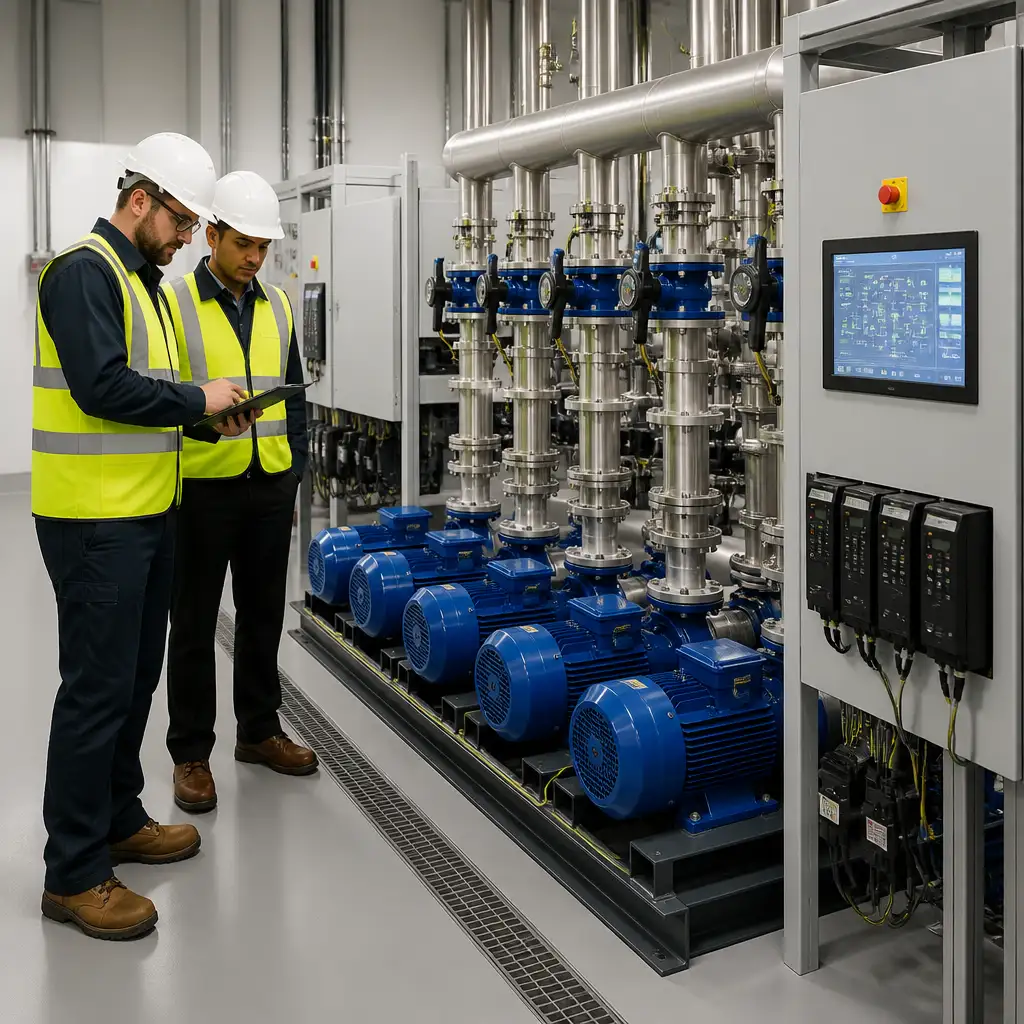
Pumps form critical single points of failure in many systems: refrigeration condensate and brine circulation, seawater intakes, boiler feeds, chilled water distribution, and process transfer lines. A failed pump can halt production, lead to product loss in cold storage, or create safety and environmental risks. Designing redundancy means ensuring that a system can continue operating at required capacity when one component fails or is taken offline for maintenance.
Key technical variables include required flow and head, turndown capability, fluid properties, suction conditions, NPSH margin, and electrical supply characteristics. These parameters determine whether redundancy is achieved by parallel identical pumps, a standby spare, oversized duty pumps, or variable-speed solutions. Early engagement with equipment suppliers and engineering consultation helps match redundancy concepts to operational goals and budget constraints—consider contacting NEMES for engineering consultation and equipment recommendations via the equipment sales resource.
Why It Matters
Reducing unplanned downtime has direct financial and operational benefits. In food processing and cold storage, downtime risks product spoilage and regulatory complications. On vessels, pump failure can affect propulsion, ballast, or refrigeration systems with operational and safety consequences. Reliable pump redundancy design improves uptime, simplifies maintenance scheduling, and reduces the likelihood of emergency field service.
Beyond uptime, redundancy design affects lifecycle costs: capital expense, energy consumption, spare-part inventory, and maintenance labor. An over-specified redundant system can inflate initial cost and energy use; an under-specified design may invite frequent failures and emergency repairs. Engineers must therefore weigh trade-offs using run-time profiles, failure-mode expectations, and maintenance capabilities.
Common Causes or Industry Considerations
Common drivers of pump failures include motor or bearing wear, impeller blockage or erosion, seal or packing failures, suction conditions causing cavitation, and electrical faults. Environmental factors—corrosive seawater, abrasive slurries, or fluctuating temperatures—accelerate wear and influence material selection and mechanical protection strategies.
Operational practices also affect reliability: cycling pumps frequently, poor alignment, inadequate lubrication, and delayed maintenance increase failure probability. In marine settings, deck vibration and limited access complicate repairs; in plants, constrained mechanical rooms can limit maintenance access. These operational realities should guide redundancy choices and layout planning.
Regulatory and safety requirements—especially for seawater systems, boiler feed, or chilled water to critical processes—may mandate minimum redundancy levels or lockout logic. Evaluate applicable codes and ensure control logic supports safe transitions between pumps.
Engineering or Operational Solutions
Several architectural approaches are common in pump redundancy design. The selection should align with required reliability, acceptable capacity loss during an outage, and budgetary constraints. Typical options include:
- N+1 redundancy: N pumps sized to handle normal load plus one spare for failover.
- Parallel duty/standby: identical pumps where one or more operate while others are on standby.
- Load-sharing with VFDs: multiple pumps modulated by Variable Frequency Drives to meet varying demand efficiently.
- Oversized duty: single larger pump with partial redundancy provided by elevated capacity; typically a stopgap.
Control logic and electrical design play a pivotal role. A robust PLC or pump controller should handle automatic failover, lead rotation for equalized run hours, and permissive interlocks to avoid simultaneous starts that exceed electrical limits. Integration with plant SCADA and alarm management enables prompt diagnostics and reduces mean time to repair.
Soft starters and VFDs each offer advantages. Soft starters reduce mechanical and electrical stress during starting but do not provide full-speed modulation. VFDs enable smooth ramping, energy savings at partial loads, and better system pressure control when multiple pumps operate in parallel. However, VFDs add capital and complexity and require proper filtering, harmonic mitigation, and motor suitability checks.
| Architecture | Reliability | Maintenance Impact | Typical Use Case |
|---|---|---|---|
| N+1 (parallel) | High—spare available | Good—allows online service | Critical chilled water, process pumps |
| Duty/Standby | Moderate—single failover | Good if isolation valves present | Seawater intakes, tank transfer |
| VFD Load Sharing | High with proper control | Requires skilled maintenance | Variable process demands, energy-sensitive systems |
| Oversized Single Pump | Low—no true redundancy | Poor—downtime during repair | Low criticality systems or budget-limited installs |
Isolation, Bypass, and Piping Considerations
Redundancy is only effective if piping and valve arrangements permit pump isolation and changeover without interrupting flow. Ball or butterfly isolation valves, check valves to prevent backflow, and bypass lines sized for minimal acceptable flow should be standard. Keep valve actuators accessible and specify full-port designs where solids or viscous fluids are involved.
Where space allows, incorporate maintenance-friendly layouts: modular pump skids, rail-mounted units for removal, and clear service clearance. On vessels and compact mechanical rooms, consider vertical multi-stage designs or remote motor arrangements to ease access.
Best Practices
Adopt a systems approach when planning pump redundancy. Best practices reduce lifecycle costs and improve maintainability:
- Right-size pumps for duty points and include NPSH margin checks to prevent cavitation.
- Standardize on pump families and motor frames where possible to reduce spare-part types.
- Design piping with isolation valves, test points, and flow measurement for commissioning and ongoing diagnostics.
- Plan electrical infrastructure for simultaneous starts and include soft starters or VFDs appropriate to motor and process needs.
- Implement control logic that supports lead rotation, alarm hierarchies, and manual override for maintenance.
- Create a spare-parts strategy: critical seals, impellers, mechanical seals, bearings, and a spare motor or VFD modules as risk-based items.
Monitoring and preventive maintenance are equally important. Install vibration sensors, motor current monitoring, bearing temperature sensors, and flow/pressure transducers. Use these inputs to build predictive maintenance schedules instead of reactive repairs—reducing emergency service calls and minimizing catastrophic failures.
Training and documentation are often overlooked. Ensure technicians understand the control logic, start-up sequences for VFDs and soft starters, and lock-out/tag-out procedures. Keep updated schematics, motor nameplate data, parts lists, and vendor manuals accessible in both print and digital formats.
How NEMES Helps
NEMES combines engineering consultation, equipment sales, and field service to support pump redundancy projects from design through long-term operation. Our engineering team helps evaluate redundancy architectures, perform pump and motor sizing, and specify control logic that meets operational and safety requirements. For equipment procurement, NEMES can source industrial pumps, motors, VFDs, soft starters, and associated controls from trusted manufacturers.
During installation and commissioning, NEMES field technicians provide on-site support and testing. If an existing system requires modernization, we offer system upgrades and troubleshooting services to integrate VFD-based load sharing, implement improved isolation piping, and add monitoring sensors. To locate parts quickly or support preventive maintenance efforts, our marine and industrial supply store maintains common replacement components and technical parts counter services.
For ongoing reliability, NEMES provides preventive maintenance planning, emergency repairs, and long-term technical support so operations can minimize downtime and extend equipment life. To discuss specific pump redundancy design needs and equipment recommendations, explore our field service and equipment selection capabilities.
Conclusion
Designing effective pump redundancy is a balance between cost, maintainability, and the required level of operational reliability. Thoughtful selection of architecture—N+1, parallel duty/standby, or VFD-enabled load sharing—paired with proper piping, isolation, control logic, and a spare-parts strategy significantly reduces the risk of unplanned downtime. Investing in monitoring and preventive maintenance further reduces lifecycle costs and improves mean time between failures.
Plant and marine engineers should engage equipment and service partners early in the design process to validate assumptions, select compatible pumps and drives, and design control systems that support safe, automatic failover. For assistance with pump selection, system upgrades, or troubleshooting, contact NEMES to leverage integrated engineering, equipment sales, and responsive field service.
For more detailed equipment options and manufacturer guidance, see our equipment sales offerings and the list of manufacturer partnerships. If you need parts or a technical parts counter for immediate replacement components, our industrial supply store is available to support maintenance and repairs. To discuss project specifics, please contact NEMES for engineering support.
Frequently Asked Questions
What is the simplest effective redundancy architecture for small facilities?
For small facilities with limited load variation, a duty/standby pair with accessible isolation valves often provides an effective and economical solution. Ensure valves and piping permit isolation and include check valves to prevent backflow.
When should I specify VFDs instead of soft starters for redundant pump sets?
Choose VFDs when the system has variable demand, when energy savings at partial load are important, or when smooth load sharing is required. Soft starters help with mechanical stress and reduced inrush but do not provide continuous speed control.
How many spare parts should a plant keep on hand for critical pump systems?
Inventory should be risk-based. Keep critical items like mechanical seals, bearings, impellers, coupling components, and a motor contactor or VFD module on-site. For higher-risk systems, a full spare pump or motor may be justified.
Can N+1 redundancy be implemented with different pump sizes?
While identical pumps simplify control and performance matching, mixed-size configurations can work if control logic compensates and system hydraulics are validated. Avoid mismatched performance curves that cause flow instability or frequent cycling.
What control features improve reliability during automatic changeover?
Lead rotation, staggered starts to limit electrical demand, permissive interlocks to prevent simultaneous operation beyond supply limits, fault reporting, and integration with plant alarms and SCADA improve safe and reliable changeover.
How does NEMES support emergency pump failures?
NEMES provides troubleshooting, emergency repairs, and parts sourcing through our service team and supply store to minimize downtime. We also support upgrades to prevent repeat failures through improved design and preventive maintenance planning.
Selecting the right equipment is critical to long-term performance and reliability. If you’re evaluating new systems or replacing aging components, NEMES can help you identify solutions that fit your operational requirements. Call 508-999-0162 or email info@nemesinc.com to speak with our experienced team.