Upgrading an industrial refrigeration system is more than replacing old compressors or swapping refrigerants. Plant engineers and refrigeration contractors must balance reliability, lifecycle cost, maintainability, safety, and operational continuity while meeting regulatory and production demands.
This article outlines practical engineering considerations for industrial refrigeration upgrade design, including load analysis, redundancy strategies, controls integration, leak detection, and maintenance accessibility. It focuses on approaches that reduce downtime and total cost of ownership while preserving product quality and safety.
Understanding the Challenge
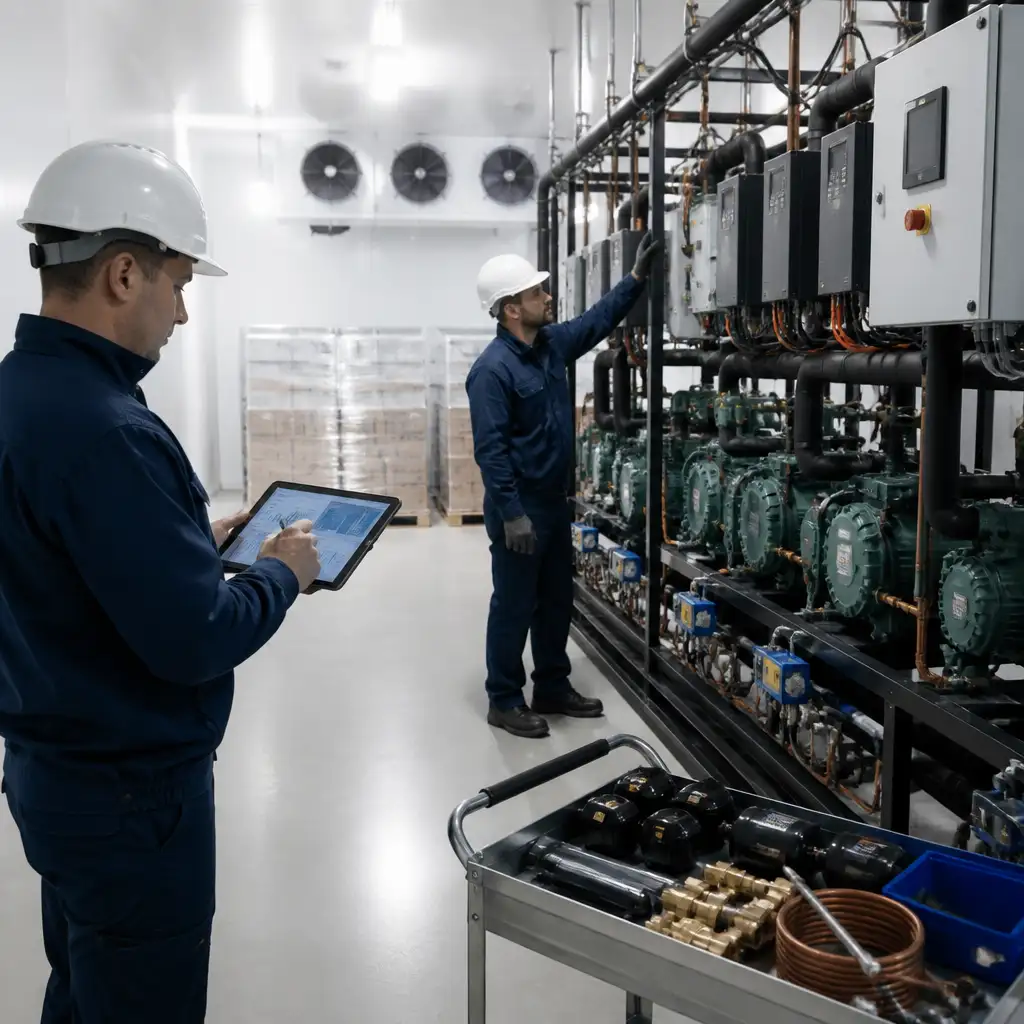
Many industrial facilities operate refrigeration systems installed decades ago. Aging compressors, obsolete controls, degraded insulation, and refrigerant phase-outs create a patchwork of issues that complicate upgrades. A successful upgrade design begins with a clear diagnostic baseline: actual cooling loads, historical operating profiles, failure modes, and process-critical priorities.
Accurate load analysis must include steady-state and transient demands, seasonal variations, and worst-case scenarios such as door openings or product surges. Electrical capacity, available mechanical room space, and access constraints also shape feasible upgrade options. Early coordination with procurement, operations, and maintenance teams prevents unexpected scope changes during implementation.
When evaluating solutions, consider long-term operational costs—energy, refrigerant, maintenance, and spare parts—not just initial capital cost. Partnering with engineering-led suppliers can streamline equipment selection and ensure the design is practical for in-plant maintenance crews.
For assistance with system evaluation and component selection, engineering consultation is available through equipment selection services that combine field experience and manufacturer knowledge.
Why It Matters
Industrial refrigeration failures impact product quality, regulatory compliance, workplace safety, and revenue. A poorly designed upgrade can introduce single points of failure, increase operating expenses, or create maintenance headaches that shorten equipment life.
Reliability reduces unplanned outages. Redundancy and maintainability design choices directly affect mean time to repair (MTTR) and mean time between failures (MTBF). Investing in maintainable layouts and service-friendly equipment often yields lower lifecycle cost than minimal-capital solutions.
Energy efficiency is another operational lever. Modern compressors, VFDs, optimized heat exchangers, and controls can reduce energy consumption significantly—payback periods vary but often contribute materially to lifecycle cost reductions.
Finally, compliance and safety requirements—particularly for ammonia (NH3) and CO2 systems—require integrated leak detection, ventilation design, and emergency isolation strategies. Design choices should anticipate inspection regimes and safety upgrades to meet current codes.
Common Causes or Industry Considerations
Understanding common failure modes and industry-specific constraints helps prioritize upgrade activities. Typical issues include:
- Undersized or poorly staged equipment that cannot meet peak loads.
- Single-point failures—single compressors, headers, or control nodes without redundancy.
- Legacy controls with no remote monitoring or poor alarm management.
- Refrigerant leaks, inadequate leak detection, and changing refrigerant regulations.
- Poor mechanical access that makes routine service slow and risky.
- Incompatible electrical infrastructure limiting the addition of VFDs or additional compressors.
Refrigerant selection is a notable consideration. Ammonia and CO2 offer performance advantages for large industrial systems but require different safety and containment strategies than HFCs. A risk-based approach—assessing toxicity, flammability, and environmental regulations—will inform whether to transition refrigerants or retain a secondary loop.
Manufacturer relationships influence long-term reliability and parts availability. Engaging with recognized suppliers during the design phase reduces lead times for replacement components and improves access to technical support and warranty services. For proven product options and manufacturer collaboration, consider reviewing available manufacturer partnerships.
Engineering or Operational Solutions
A systematic upgrade design addresses capacity, redundancy, controls, leak detection, electrical, and maintainability together rather than in isolation. Key solutions include:
- Comprehensive load analysis and capacity planning, including transient events and redundancy margins.
- Redundancy strategies such as N+1 or N+2 compressor arrangements and staged evaporator groups to isolate failures without full system loss.
- Controls modernization—PLC or distributed controllers, BACnet/Open protocols, and integration with building or plant control systems for remote monitoring and alarm escalation.
- Leak detection networks integrated with automatic isolation and ventilation interlocks for ammonia or CO2 systems.
- Electrical upgrades to support VFDs, soft starters, and harmonics mitigation to protect motors and reduce inrush currents.
- Phased implementation plans that maintain production while swaps, retrofits, and piping modifications occur.
Comparing redundancy options helps stakeholders choose appropriate levels of protection. A simple comparison is useful during early-stage design:
| Redundancy Level | Description | Pros | Cons |
|---|---|---|---|
| Single | One set of compressors/evaporators | Lower capital cost | High downtime risk |
| N+1 | Main capacity plus one spare | Good availability; common in processing plants | Moderate capital cost |
| N+2 | Extra spares for critical loads | High reliability; supports maintenance without shutdown | Higher capital and space requirements |
Controls integration is essential. Modern PLC-based systems with local HMI and remote SCADA/BMS connectivity allow for predictive diagnostics, alarm grouping, and trending. Integrate VFD telemetry and motor protection data so maintenance teams can spot bearing wear, refrigerant glide anomalies, or oil return issues before they cause failures.
Leak detection should be layered—continuous sensors in mechanical spaces, refrigerant concentration monitoring in occupied areas, and portable sniffers for routine inspection. For ammonia systems, design ventilation and emergency isolation so that detected leaks trigger sequence shutdowns, dilute ventilation, and notification to operations and emergency responders.
Phased upgrade strategies minimize production disruption. Typical phases are inspection and baseline documentation, control and monitoring upgrades, compressor and condenser swaps during planned outages, piping and valve upgrades, and final commissioning with performance testing.
Best Practices
Adopt practices that simplify maintenance and reduce lifecycle costs. Key recommendations include:
- Design for service: clear access to compressors, oil drains, filter driers, and control panels; use isolation valves and bypasses to allow sections to be serviced without full shutdown.
- Spare parts strategy: critical spares on-site for compressors, VFD modules, PLC I/O modules, and common valves reduces MTTR.
- Documentation and training: maintain updated as-built drawings, operation manuals, and a training program for on-site technicians.
- Preventive maintenance schedules tied to sensor data and run-hours rather than time-only intervals.
- Energy optimization: consider heat reclaim, staging optimization, and VFD tuning to reduce operational expense.
Include a concise risk-assessment checklist early in the project to guide priorities and quantify exposure. A recommended checklist includes:
- Critical loads and acceptable downtime for each production area.
- Single-point failure identification and mitigation measures.
- Availability of spare parts and vendor support for installed equipment.
- Electrical capacity and proposed power upgrades.
- Safety systems: leak detection, ventilation, and emergency isolation.
- Phasing plan and temporary cooling strategies during cutovers.
How NEMES Helps
NEMES combines engineering-first consulting, equipment selection, supply, and field service to support industrial refrigeration upgrade design from concept to long-term operations. Our approach begins with an on-site assessment to document existing equipment, measure loads, and identify maintenance constraints.
We support clients with detailed engineering consultation and equipment recommendations that consider lifecycle cost, maintainability, and safety. NEMES helps select compressors, VFDs, controls, and leak detection systems that match the operational profile and spare-parts strategy for your facility.
Our field capabilities include installation support, commissioning, and preventive maintenance programs. When upgrades require careful staging to avoid production loss, our technicians coordinate with plant teams to execute phased implementations and provide temporary cooling solutions when necessary. Learn more about our field service offerings and preventive maintenance planning.
In addition to in-stock components and parts from our marine and industrial supply store, NEMES leverages long-standing manufacturer partnerships to secure critical components, technical data, and factory support for commissioning and warranty coordination.
Conclusion
Designing an industrial refrigeration upgrade requires a systems-level approach that balances immediate capital costs with long-term reliability, maintainability, and energy use. Prioritize accurate load analysis, appropriate redundancy, modern controls integration, layered leak detection, and serviceable layouts to reduce downtime and total cost of ownership.
Phased upgrade strategies, a clear risk-assessment checklist, and collaboration with experienced manufacturer partners reduce implementation risk and improve operational outcomes. Engaging an engineering-led partner early in the process helps translate operational priorities into practical, maintainable designs.
If you are planning an upgrade or evaluating replacement options, we encourage you to document critical loads, identify single-point failures, and assemble a phased implementation plan. When you’re ready to discuss technical options and equipment recommendations, please contact NEMES to request engineering support.
Frequently Asked Questions
1. What is the first step in an industrial refrigeration upgrade?
Begin with a comprehensive site survey and load analysis to document current performance, peak and transient loads, and failure history. This baseline guides all design decisions and phasing plans.
2. How much redundancy should my system have?
Redundancy depends on the criticality of the load. Many facilities use N+1 for general operations and N+2 or dual systems for mission-critical processes. Perform a risk assessment to balance cost and availability.
3. Should I replace refrigerants during an upgrade?
Consider refrigerant replacement when regulations, performance benefits, or lifecycle costs justify it. Transitioning to ammonia or CO2 may improve efficiency for large systems but requires updated safety controls and containment strategies.
4. How can controls improve reliability?
Modern PLC/BMS integration enables predictive maintenance, alarm hierarchy, and remote monitoring—reducing unplanned downtime by detecting developing issues early and optimizing staging and energy use.
5. What maintenance practices reduce lifecycle costs?
Design for service access, maintain critical spares on-site, use sensor-driven preventive maintenance, and provide operator training. These practices lower MTTR and extend equipment life.
6. How do phased upgrades work to avoid production loss?
Phased upgrades sequence work during planned outages, install temporary cooling where required, and isolate system sections so production areas remain operational while components are replaced or retrofitted.
Selecting the right equipment is critical to long-term performance and reliability. If you’re evaluating new systems or replacing aging components, NEMES can help you identify solutions that fit your operational requirements. Call 508-999-0162 or email info@nemesinc.com to speak with our experienced team.