Although examples focus on refrigeration systems and pumps, the principles apply to compressors, motors, controls, and other critical systems. Where helpful, you’ll find sample schedules and inventory rules that maintenance teams can adapt to facility size and operational risk.
Understanding the Challenge
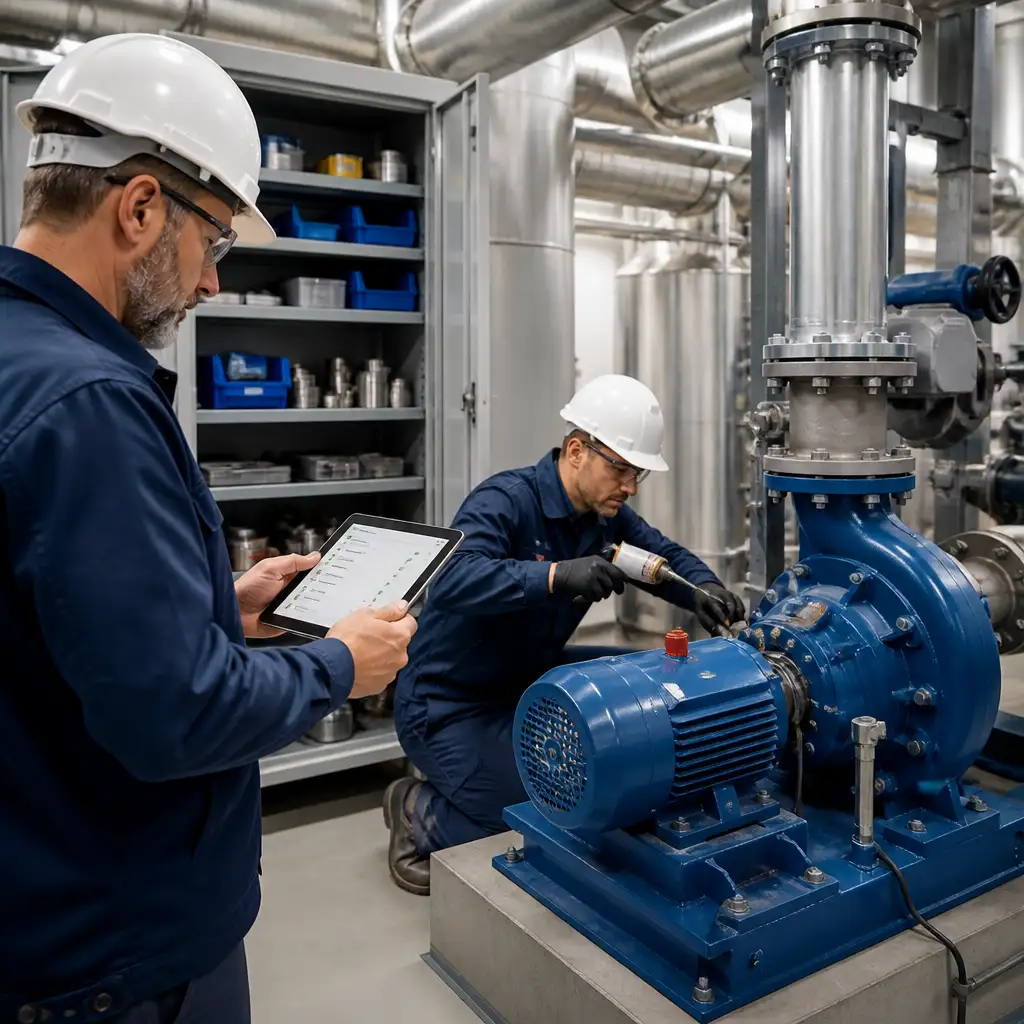
Maintenance teams face three linked challenges: unpredictable failures, limited parts availability, and delayed service response. Equipment failures in refrigeration racks or centrifugal pumps can quickly escalate into product loss, safety risks, and costly overtime. For marine operators and industrial processors, a single compressor or pump failure may halt operations, creating immediate logistic and financial pressure.
Complicating the problem are long lead times for OEM components, limited in-house diagnostic capability, and incomplete maintenance records. Without a structured preventive maintenance program and a categorized spare-parts strategy, many facilities default to reactive repairs—resulting in higher emergency service calls and shorter asset life.
Addressing these challenges requires integrating maintenance planning with parts procurement and service readiness so that when alarms occur, the outcome is predictable and controlled instead of disruptive and costly.
For teams evaluating their programs, consider reviewing existing preventive maintenance procedures and service contracts to ensure they align with operational risk and manufacturer requirements. If you need assistance, NEMES provides preventive maintenance services and responsive technical support to help structure an effective program.
preventive maintenance and field service options from experienced providers can reduce emergency call frequency and shorten repair time when failures occur.
Why It Matters
Downtime has immediate and cumulative consequences. In cold storage and food processing, temperature excursions risk product spoilage and regulatory non-compliance. In marine operations, refrigeration or pump failures disrupt voyages and cargo handling. Industrial facilities face lost production hours, expedited shipping costs for replacement parts, and potential contractual penalties.
Investing in preventive maintenance for industrial equipment reduces unplanned downtime, lowers lifecycle costs, and improves safety. Proper PM also provides early detection of wear and degradation—allowing planned repairs at convenient times rather than emergency interventions.
From a financial perspective, shifting resources from emergency service calls to scheduled work often reduces total maintenance spend: labor is scheduled, parts are bought at standard freight rates, and overtime premiums are minimized. Operationally, planned interventions preserve throughput and protect product integrity.
Common Causes or Industry Considerations
Frequent emergency repairs typically result from a handful of avoidable conditions:
- Insufficient PM coverage or missed PMs (low PM compliance)
- Poor spare parts planning—critical components not stocked or long supplier lead times
- Lack of diagnostic data (no vibration, oil analysis, or thermography)
- Aging equipment with deferred replacements or incompatible legacy parts
- Inadequate field service options or slow parts fulfillment
Industry-specific considerations matter. Refrigeration systems require seasonal load planning and refrigerant monitoring (especially CO₂ or ammonia systems). Pumps used in marine or processing environments must be evaluated for sea-water corrosion, seal wear, and variable flow demands. Controls and VFDs introduce an electrical and software dimension that requires both electrical expertise and spare electronic modules.
Supply chain variability also affects stocking strategies. If certain OEM parts experience long lead times, that elevates the part’s criticality classification and necessitates on-site stocking or an agreement with a local supplier.
Engineering or Operational Solutions
Designing an effective program begins with risk-based maintenance planning. Start by classifying assets by criticality: which pieces of equipment would stop operations or risk product integrity if they failed? Use that classification to prioritize PM frequency and spare parts stocking.
Key engineering and operational solutions include:
- Risk-based PM schedules tied to OEM guidance and operational duty cycles
- Condition monitoring—vibration analysis, infrared thermography, oil and refrigerant analysis—targeted to critical assets
- Standardized procedures and checklists to ensure PM compliance and repeatability
- Spare parts strategy based on criticality, lead time, and cost; include local stocking for critical items
- Service-level planning that defines response times, mobile inventory, and escalation paths to minimize MTTR
Technology supports these solutions. A reliable CMMS helps schedule PMs, track completion rates, record failures, and trigger purchasing workflows. Remote monitoring and alarms enable off-site diagnostics and faster triage before a technician arrives.
When equipment selection or upgrades are needed, engineering consultation ensures replacement components reduce maintenance burden—choosing pump seal types, VFD-compatible motors, or refrigeration compressors with better parts availability can lower long-term downtime risk.
Sample Preventive Maintenance Schedule
Below is a concise PM schedule example that maintenance managers can adapt. Frequencies assume normal duty; adjust based on operating hours and severity.
| Asset | Weekly | Monthly | Quarterly | Annual |
|---|---|---|---|---|
| Refrigeration rack (compressors & controls) | Visual checks, alarms, condensing temps | Oil level, refrigerant charge check | Clean condensers, inspect relief valves, control calibration | Compressor teardown inspection, replace oil filter, full system performance test |
| Centrifugal pumps | Leak and vibration walk-around, suction/discharge readings | Coupling alignment, seal condition, base bolt torque | Impeller inspection, bearing checks | Rebuild or replace seals and bearings, dynamic alignment, performance curve validation |
Best Practices
Implement these practical steps to reduce emergency repairs and downtime:
- Adopt risk-based PMs: Prioritise assets that impact production, safety, or regulatory compliance.
- Use condition-based triggers: Combine scheduled PMs with condition monitoring to catch degradation early.
- Classify spare parts (A/B/C): Critical (A): on-site stock; Important (B): regional stock or fast freight; Routine (C): order as needed.
- Define service levels: Create response tiers (e.g., emergency within 4–8 hours, urgent within 24 hours, planned within 72 hours) and match parts and staffing to those tiers.
- Track KPIs: PM compliance, emergency calls per month, mean time to repair (MTTR), mean time between failures (MTBF), parts fill rate, and inventory turns.
- Optimize inventory with reorder points: Reorder Point = (Average daily usage × Lead time days) + Safety stock. For critical items, maintain a minimum on-hand quantity of 1–2 spares depending on lead time.
- Stage critical spares for rapid dispatch: Use a mobile van stock or central parts cabinet near high-risk areas to reduce response time.
- Document and update procedures: Maintain PM checklists, failure histories, and parts usage logs to refine schedules and stocking rules.
Inventory guidelines — practical thresholds:
- Critical compressor parts (valve plates, gaskets, relief valves): keep at least one service kit and one extra valve plate if lead time exceeds two weeks.
- Pump mechanical seals: keep one spare seal per pump plus a small selection of common sizes for quick swaps.
- VFD modules and control spare boards: prioritize based on failure history; keep one replacement module for critical drives.
- Common consumables (filters, belts, lubricants): maintain monthly minimums based on consumption history.
Link inventory policy to your procurement process. For parts you do not regularly stock, establish vendor lead times and expedited options. When possible, standardize hardware across systems to reduce unique part types.
For purchasing and in-store support, many operations rely on a well-stocked local supply. Our marine and industrial supply store maintains in-stock industrial supplies and hard-to-find replacement components that help teams execute PMs without delay.
marine and industrial components and replacement parts can reduce lead times for common refrigeration and pump parts.
How NEMES Helps
NEMES integrates engineering, equipment sales, supply, and field service to support preventive maintenance programs and rapid repairs. Our engineering team can help design PM schedules tailored to refrigeration systems, pumps, motors, and controls; we combine that with product sourcing and parts availability from our supply store.
Key ways NEMES supports customers:
- Engineering consultation and equipment recommendations to reduce maintenance burden and improve parts availability—learn more about our equipment sales and engineering consultation services.
- On-site and emergency field service—our technicians provide troubleshooting services, preventive maintenance, and emergency repairs to restore operation quickly.
- Stocked parts and technical parts counter—our store supports maintenance programs with replacement components and technical sourcing for hard-to-find items.
- Long-term support—documentation, spare-parts planning, and service-level agreements to help reduce emergency calls and lower lifecycle costs.
When teams need a balanced approach—engineering-led PMs, stocked spares, and rapid field response—NEMES works as a long-term technical partner to implement sustainable reliability programs.
For questions about developing a PM strategy, spare parts plan, or establishing service levels, you can contact NEMES to request technical assistance.
Conclusion
Reducing emergency repairs and downtime requires a cohesive strategy: risk-based preventive maintenance, categorized spare parts inventory, and well-defined service levels supported by rapid field service. Condition monitoring, PM compliance, and relevant KPIs help maintenance managers move from reactive to proactive maintenance—saving time, lowering costs, and extending equipment life.
Start by classifying critical assets, creating standardized PM procedures, and aligning spare parts stocking to lead times and failure modes. Leverage vendors and local supply channels to shorten parts lead times, and consider mobile inventory or service agreements for high-risk assets. Over time, measured improvements in MTBF, reduced emergency calls, and lower outage hours will validate the program.
For assistance implementing these practices—especially for refrigeration systems, pumps, and associated electrical controls—NEMES offers practical engineering guidance, stocked replacement parts, and responsive field service to support your operation.
Request engineering support or discuss customized preventive maintenance services tailored to your assets and operational risk.
Frequently Asked Questions
What is the single most effective step to reduce emergency repairs?
Implementing and enforcing a risk-based preventive maintenance program with PM compliance tracking is the single most effective step. Regular inspections and condition monitoring catch issues before they cause failures.
How many spare parts should a facility keep on-site?
Stocking levels depend on criticality and lead time. For critical items with long lead times, keep at least one to two on-site spares. For routine consumables, maintain a monthly minimum based on usage history.
Which KPIs should maintenance managers track first?
Begin with PM compliance rate, emergency calls per month, MTTR, MTBF, and parts fill rate. These provide clear insight into program effectiveness and areas needing investment.
How can I shorten mean time to repair (MTTR)?
Reduce MTTR by staging critical spares, improving diagnostic capability (remote monitoring and checklists), training technicians, and securing rapid vendor support or local supplier agreements.
Are remote diagnostics useful for refrigeration and pump systems?
Yes. Remote alarms, trend data, and pre-arrival diagnostics allow technicians to prepare appropriate parts and tools, which shortens repair time and reduces repeat trips.
Who should I contact for help designing a PM program?
Contact a trusted engineering and service partner that combines equipment knowledge, parts sourcing, and field service experience to design and implement a PM program suited to your operation.
Routine maintenance can extend equipment life and reduce the risk of unexpected failures. If you’re developing a preventive maintenance strategy or evaluating aging equipment, NEMES can help you keep critical systems operating at their best. Call (800) 540-8893 or email info@nemesinc.com to discuss your service needs.