Falling film chiller pumps are a critical component in industrial refrigeration and process cooling systems. Selecting the right pump hydraulics, materials of construction, control strategy, and redundancy approach reduces fouling, cavitation, and unplanned downtime while improving long-term maintainability. This guide walks plant and marine engineers through the engineering decisions that matter when specifying pump systems for falling film chillers.
Throughout the article we focus on practical, serviceable choices—pump hydraulics, NPSH and cavitation avoidance, materials for corrosive or seawater environments, VFD and control integration, redundancy options, and testing and commissioning procedures that help avoid common operational failures.
Understanding the Challenge
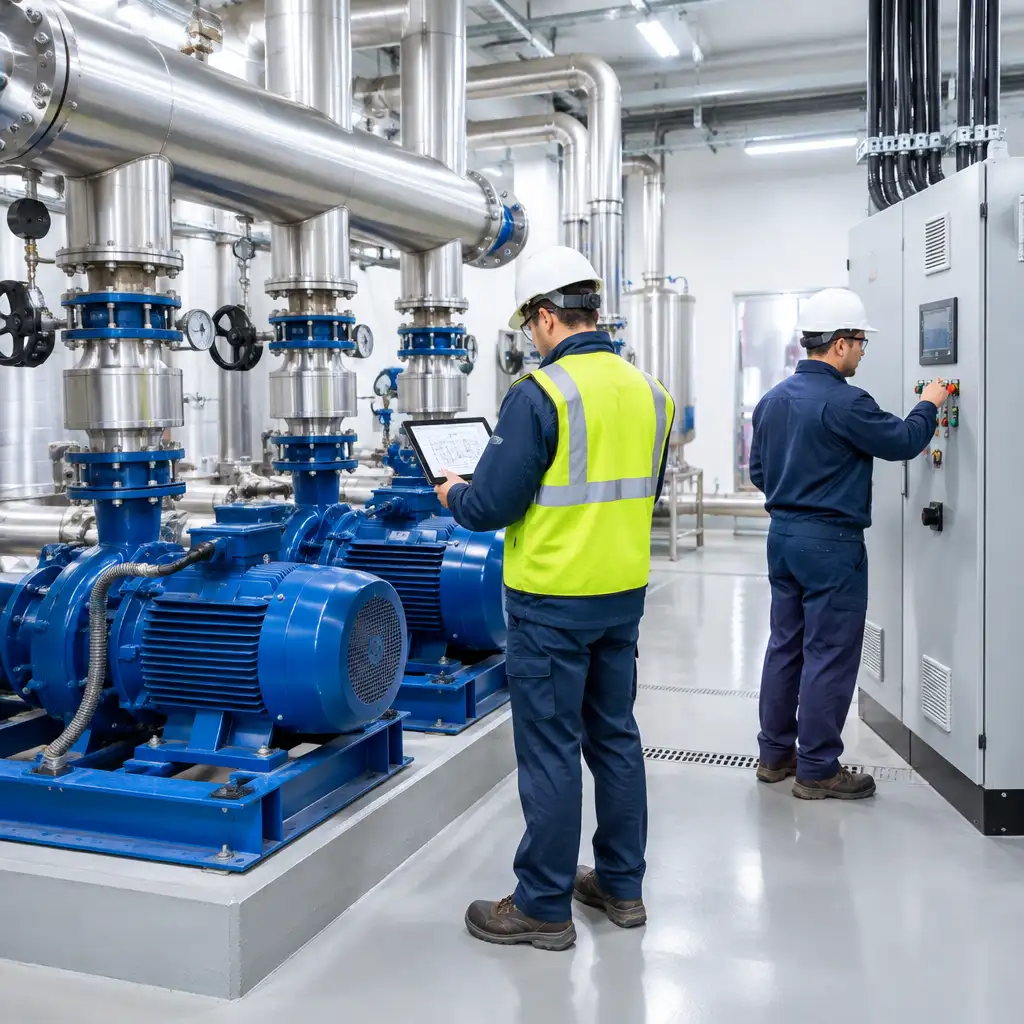
Falling film chillers rely on a thin film of refrigerant or secondary fluid flowing across heat-exchange surfaces. The fluid velocity and even distribution across the bundle are key to heat transfer performance. Pumps must deliver steady, low-pulsation flow at the required head while handling whatever secondary fluid the system uses—glycol solutions, brines, or seawater in some Refrigerated Sea Water (RSW) applications.
Key hydraulic considerations include the total dynamic head (TDH) of the recirculation loop, pressure losses through distribution nozzles and headers, and transient events during defrost or rinse cycles. Pump selection must also anticipate particulate or biological fouling, variable viscosity from glycol concentration, and low NPSH conditions in suction tanks or sums.
Specify pumps with an operational map that keeps them near their best efficiency point (BEP) for the majority of run hours. When in doubt, perform a system hydraulic review and pump curve matching during the design phase—an engineering activity NEMES supports through equipment sales and specification assistance.
Why It Matters
Poor pump selection or control leads to familiar failures: cavitation damage to impellers, seal failures, increased energy use, frequent maintenance, and uneven refrigerant film that reduces chiller performance. Each of these issues contributes to unplanned downtime and higher lifecycle costs.
For marine and industrial facilities, these consequences can be amplified. A failing pump on a falling film chiller in a seafood processor or onboard refrigeration system can halt production or compromise product quality. Properly specified pumps reduce vibration, minimise mechanical seal replacements, and cut energy consumption through efficient operation with Variable Frequency Drives (VFDs).
In short, investing engineering time in hydraulics, materials, and control integration up front pays back in reduced maintenance, longer component life, and more predictable operations.
Common Causes or Industry Considerations
Understanding common failure modes helps prioritize specification details:
- Fouling and scaling from suspended solids, minerals, or biological growth, particularly in seawater or hard-water systems.
- Cavitation initiated by insufficient NPSH, high local velocities, or gas entrainment in the suction line.
- Operational off-BEP running caused by throttling, poorly tuned controls, or oversized pumps.
- Material incompatibility—galvanic corrosion or pitting in aggressive fluids or saline environments.
- Control mismatch—VFDs without proper PID tuning, poor sensor placement, or lack of anti-cavitation logic.
These issues are common across industrial refrigeration, marine refrigeration, and other HVAC/R installations. Addressing them during specification reduces the need for emergency service later; see our preventive maintenance and field support offerings for long-term reliability strategies.
Engineering or Operational Solutions
Hydraulics and pump type selection
Select centrifugal pumps sized so the BEP aligns with expected operating flow. For smaller closed-loop falling film chillers, close-coupled end-suction or inline centrifugal pumps are common. For larger duty or seawater systems, consider vertical multistage or sealless canned-motor pumps that reduce leakage risk.
| Pump Type | Suitability | Pros | Cons |
|---|---|---|---|
| End-suction centrifugal | General brine/glycol loops | Low cost, easy maintenance | Requires shaft seals; suction piping matters |
| Vertical multistage | High head, compact footprint | Good NPSH characteristics, close to BEP | More complex internals; higher initial cost |
| Canned motor / sealless | Corrosive or leak-sensitive fluids | No shaft seal leak paths, good for hazardous fluids | Repair often requires full unit replacement |
| Mag-drive | Clean, low-temp brines | Sealless, low maintenance | Temperature/viscosity limits; not for solids |
Materials of construction
Choose materials that match the secondary fluid. For glycol or inhibited brines in industrial refrigeration, 304 or 316 stainless steel is common; 316 or duplex stainless for seawater and highly corrosive environments. Bronze and Cu-Ni alloys are still used in marine RSW systems where biofouling and galvanic compatibility are considerations. When ammonia or CO₂ are present in adjacent systems, ensure materials and seals are compatible with the secondary loop chemistry.
VFD and control integration
Implement VFD control to keep pumps operating near BEP across varying load conditions. Use a control loop based on flow or differential pressure with properly located sensors: suction pressure for anti-cavitation logic, discharge pressure for flow control, and a flow meter in critical applications. Program soft acceleration and deceleration ramps, anti-starvation logic, and torque limits to prevent cavitation and mechanical stress. Avoid simple discharge throttling to control flow; speed control is more efficient and preserves pump hydraulics.
Redundancy and operational strategies
Design redundancy into critical systems: lead-lag duplex configurations with automatic changeover, parallel pumping for turndown, or standby units that can be manually or automatically placed into service. Ensure each pump has isolation valves, check valves, and the ability to be exercised during routine maintenance. A two-pump duty with periodic lead rotation reduces single-point failure risk and limits fouling accumulation during extended idle times.
Best Practices
Prevent fouling and maintain film distribution
- Specify adequate velocity in headers and distribution lines to minimise sedimentation—typically 1–1.5 m/s as a starting point depending on fluid.
- Install a strainer or self-cleaning filter ahead of the pump suction to trap debris and biological solids while avoiding excessive pressure drop.
- Design distribution manifolds for equal flow paths and include balancing valves or orifice plates to tailor flow across the chiller surface.
Minimise cavitation risk
- Calculate NPSHa early and compare to NPSHr at the expected operating point. Maintain an engineering margin—typically several feet/metres—to allow for seasonal or transient pressure changes and to protect the impeller from damage.
- Keep suction piping short, straight, and with gradual bends. Avoid high points that trap air; provide venting or air separators where gas entrainment is possible.
- Consider an inducer or vertical inline pump if inlet conditions are marginal.
VFD commissioning and control tuning
- Commission VFDs with factory and on-site tests: verify torque limits, carrier frequencies, braking, and surge protection. Use soft-start settings during initial commissioning runs.
- Tune PID loops using measured system response; don’t rely on default VFD settings. Include anti-windup and bumpless transfer logic for manual overrides.
Spare parts and maintainability
- Stock critical spares: an extra mechanical seal, shaft sleeve, impeller, bearing sets, and a VFD spare module where reliability is paramount.
- Design the layout for access: removable baseplates, space for a temporary pump on a trolley, and clear isolation points simplify repairs and reduce downtime.
How NEMES Helps
NEMES combines engineering consultation, equipment sales, and responsive field service to support customers specifying falling film chiller pumps. Our engineering team assists with system hydraulic reviews and pump curve matching so pumps operate at or near BEP and avoid common cavitation issues. We provide tailored equipment recommendations and help select appropriate materials based on fluid chemistry and marine or industrial exposure.
Through our marine and industrial industrial supply store we source replacement parts, strainers, sensors, and mechanical seals that keep pumps running. Our field technicians deliver commissioning, VFD integration, and preventive maintenance services—if a problem arises, our field service group provides troubleshooting and emergency repairs to reduce downtime and restore reliable operation.
We also work with a wide range of trusted manufacturers to provide pump packages and controls that fit operational requirements. Whether you need specification assistance for a new plant, system upgrades to reduce fouling, or long-term maintenance planning, NEMES supports customers with engineering-first recommendations and supply chain capability.
Testing, Commissioning and Ongoing Verification
Factory Acceptance and site testing are essential. Require FAT documentation that includes certified performance curves, vibration readings, motor current, and alignment checks. On-site pre-commissioning should confirm suction conditions, verify NPSHa with tank and piping elevations, and check for air entrainment or leaks.
During commissioning, collect baseline data: flow, suction and discharge pressures, motor amps, vibration spectra, and thermography on bearings and motor housings. Establish alarm thresholds on VFDs and control panels for low suction pressure, high vibration, or overcurrent conditions.
Implement a preventive and predictive maintenance program that includes routine strainer cleaning, seal inspections, vibration and bearing temperature trending, and occasional pump performance tests to detect degradation before failure. NEMES provides preventive maintenance planning and on-site support to implement these checks.
Conclusion
Specifying reliable falling film chiller pumps requires an integrated approach: match hydraulics to system requirements, choose materials for the operating environment, integrate VFDs and control logic properly, design redundancy for critical loads, and validate performance through FAT and on-site commissioning. These engineering decisions reduce fouling, minimise cavitation, and cut unplanned downtime—improving lifecycle costs and operational confidence.
Early collaboration between process engineers, pump manufacturers, and service providers allows for realistic NPSH assessments, appropriate spare part lists, and control strategies that keep pumps operating near BEP. For marine and industrial refrigeration systems, this results in more consistent cooling performance and fewer emergency repairs.
When you’re ready to evaluate pump options or develop a maintenance and control strategy for falling film chillers, contact NEMES for engineering guidance, equipment sourcing, and field support that integrates design, parts, and service.
Explore our equipment sales offerings and contact our team to request technical assistance; you can also contact NEMES directly to discuss project requirements.
Frequently Asked Questions
Q: What pump types are best for falling film chillers?
A: For most closed-loop falling film chillers, properly sized centrifugal pumps (end-suction or inline) work well. For seawater or leak-sensitive systems consider sealless canned-motor or magnetic-drive options. Match BEP to expected operating flow and consider multistage vertical pumps for high-head duties.
Q: How do I prevent cavitation in low-suction-head systems?
A: Design for adequate NPSHa with margin, shorten suction piping, avoid high points, and use VFD anti-cavitation logic. If NPSHa is marginal, consider inducers or vertical inline pumps with better suction performance.
Q: Which materials resist fouling and corrosion in marine RSW applications?
A: Duplex or 316 stainless steel is common for seawater exposure; bronze or copper-nickel alloys may be appropriate where galvanic compatibility and biofouling resistance are required. Select materials based on actual water chemistry and consult manufacturer compatibility charts.
Q: Should I control flow with a VFD or a control valve?
A: Use a VFD for primary flow control to keep the pump near BEP and improve efficiency. Avoid heavy throttling with control valves at the pump discharge since that increases energy use and moves the pump off its optimal operating point.
Q: What tests should be included in commissioning?
A: Include FAT-certified performance testing, vibration and alignment checks, motor current and thermal checks, NPSH verification, and functional testing of VFD and control logic. Collect baseline measurements for future predictive maintenance.
Q: How many spares should I keep on site?
A: At minimum, stock a mechanical seal kit, an extra impeller or shaft sleeve, bearing replacements, and common gaskets. For critical installations, include a spare VFD module and a standby pump to reduce downtime.
Selecting the right equipment is critical to long-term performance and reliability. If you’re evaluating new systems or replacing aging components, NEMES can help you identify solutions that fit your operational requirements. Call (800) 540-8893 or email info@nemesinc.com to speak with our experienced team.