Seasonal peaks in product volume—holiday produce, fisheries landings, or promotional inventory—can quickly exceed a distribution center’s available refrigeration. Operations and facility managers must decide whether to accept elevated risk, delay shipments, or deploy temporary capacity to preserve throughput and product integrity. This guide presents a practical decision framework comparing modular cold rooms, temporary chillers, staging controls, and energy-management tactics that help avoid product loss while minimising lifecycle cost.
The recommendations below focus on operational impact: how quickly each option can be deployed, permitting and site-prep realities, controls integration, and the total cost of ownership. Readers will also find best practices for sequencing temporary measures and when to call in engineering support for integrated solutions.
Understanding the Challenge
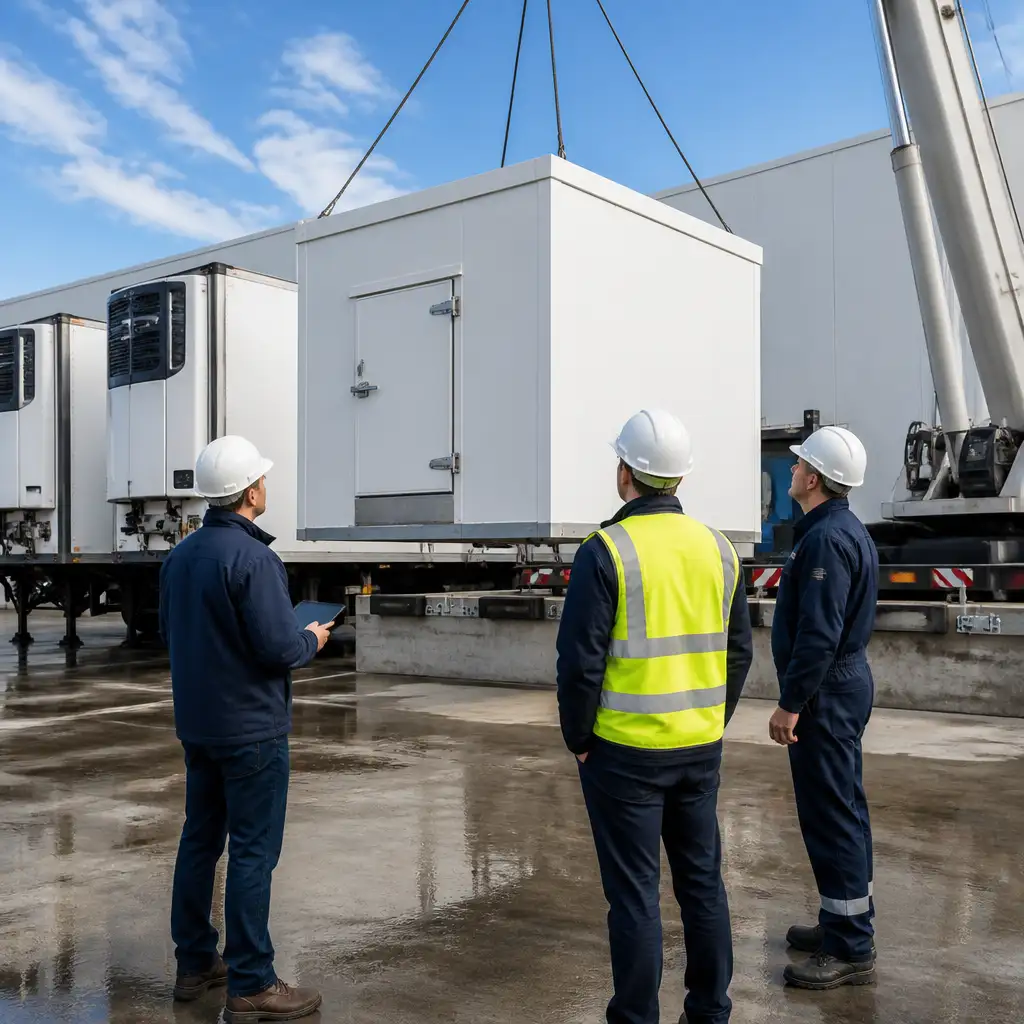
Seasonal cold storage capacity shortfalls arise when refrigerated throughput (incoming goods, processing, and outbound shipments) temporarily exceeds the installed refrigeration and footprint. Unlike permanent expansions, temporary solutions must balance speed, safety, and cost. The most common temporary approaches are modular cold rooms, trailer-mounted chillers, and reconfiguring staging and controls to prioritise critical loads.
Key technical constraints include available electrical service, distribution of refrigeration loads across compressors and condensers, control logic limits, and physical staging or racking space. An engineering-led assessment clarifies whether the bottleneck is thermal capacity, freezing rate, airflow distribution, or logistics—each requires a different temporary strategy.
Early engagement with equipment suppliers and engineering consultation can shorten lead times. For example, reviewing available solutions through an experienced provider for equipment recommendations and rapid procurement can reduce downtime and ensure compatibility with existing industrial refrigeration systems.
Why It Matters
Temperature-sensitive product loss is expensive and can damage brand reputation. Even short excursions above target temperatures can force product disposition, trigger recalls, or create regulatory non-compliance. Maintaining throughput during surges keeps orders on time and reduces labour inefficiencies from stop-start workflows.
Energy and lifecycle costs also matter. A temporary chiller deployed rapidly but run inefficiently through peak weeks can impose high utility bills and wear on compressors. Conversely, a modular cold room that ties into central plant controls can be more energy-efficient but may take longer to permit and install.
Given these trade-offs, operations managers need a decision framework that weighs speed, cost, controls integration, permitting risk, and long-term asset implications rather than making ad hoc choices under pressure.
Common Causes or Industry Considerations
Understanding root causes helps select the right temporary measure. Typical causes for seasonal shortages include:
- Concentrated inbound arrivals (e.g., seasonal harvests or fisheries) that exceed daily freezing or chilling throughput.
- Promotional or retail cycles that shift storage demand unpredictably.
- Planned downtime for preventive maintenance coinciding with peak season.
- Equipment derating caused by high ambient temperatures or refrigerant shortages.
- Floor space and racking constraints preventing redistribution of inventory.
Operational considerations that affect temporary solutions include electrical capacity, rooftop or yard space for temporary units, local permitting and fire code requirements for flammable refrigerants, and staffing for installing and operating the equipment.
Before selecting a strategy, conduct a quick load profile: estimate peak and average refrigeration loads (kW or TR), required temperature setpoints, required freezing rate (for blast or plate freezing), and available electrical and physical infrastructure. This profiling simplifies the choice between adding heat-extraction capacity (temporary chillers) or creating additional conditioned volume (modular cold rooms).
Engineering or Operational Solutions
Below is a practical comparison of common temporary expansion choices and their operational implications. Use this framework to match a solution to your timeline, risk tolerance, and budget.
| Option | Deployment Speed | Controls Integration | Permitting & Site Prep | Typical Lifecycle Cost Considerations |
|---|---|---|---|---|
| Modular Cold Rooms (prefab panels) | Days–weeks, depends on site prep | Moderate — can integrate with existing sensors and controls | Floor loading, fire egress, and local building codes; often minimal refrigerant permitting if connected to plant | Moderate capital; reusable for future seasons; low energy if properly insulated |
| Trailer-Mounted / Rental Chillers | Hours–days (rental fleets) | Basic — typically operate standalone; can be tied into plant controls with work | Space and access for trailers; noise and emissions considerations; generator use if grid power limited | Lower up-front capex but higher operational (rental + fuel/electric) costs during long deployments |
| Temporary Refrigerated Trailers (reefers) | Hours–days | Standalone control; minimal integration | Yard space and level surface; loading/unloading workflow adjustments | Low capital; flexible; higher per-unit energy cost; minimal integration complexity |
| Staging Controls & Load Prioritisation | Hours–days (software/logic updates) | High — requires control programming, VFD coordination, and sensor reconfiguration | Typically low; dependent on control panels and allowed changes | Low capex; high operational efficiency; reduced peak demand charges if implemented properly |
| Energy Management (TES, VFDs, demand response) | Weeks–months to implement fully | High — deep integration with electrical systems and building controls | Electrical upgrades and approvals often required | Higher capex but long-term savings; reduces peak demand and lifecycle costs |
Operational examples:
- If you need immediate, mobile capacity for weeks: rented chillers or refrigerated trailers provide the fastest relief.
- If space is available and the same surge recurs annually: a modular cold room may offer the best lifecycle value and energy efficiency.
- If electrical capacity is the constraint: implement staging controls and VFDs to shift or shave loads before adding capacity.
Best Practices
The following best practices reduce risk and shorten deployment time for temporary seasonal cold storage capacity:
- Start with a load-profile and risk matrix: quantify the surge, critical SKUs, acceptable temperature tolerances, and financial exposure for product loss.
- Prepare a site checklist ahead of peak season: identify level yard areas, electrical connection points, required concrete pads, and forklift access routes.
- Engage permitting and fire-safety teams early: temporary refrigerant equipment and insulated rooms can trigger local inspections or specific fire-suppression requirements.
- Plan controls integration from the start: mapping inputs/outputs, setpoints, alarm routing, and historian logging avoids surprises when linking modular systems to your building management system or industrial controls.
- Use preventive maintenance and commissioning: have technicians verify refrigerant charge, airflow balance, and sensor calibration before putting temporary systems into service.
- Consider lifecycle costs: evaluate not only rental and installation costs, but energy consumption, maintenance, potential upgrades to electrical service, and resale/reuse value.
- Document SOPs and training for staff: procedures for trailer loading, defrost cycles, and emergency procedures keep operations reliable during surges.
For in-season responses, triage is essential: prioritise critical loads (perishable SKUs) to the most reliable refrigeration source while using temporary capacity for overflow. Maintain clear communication between operations, refrigeration technicians, and inventory planning teams.
When rapid parts or components are needed—sensors, VFDs, or compressor parts—having access to an on-site or nearby industrial supply reduces downtime. Consider maintaining a seasonal parts list stocked at your supply counter.
How NEMES Helps
NEMES combines engineering consultation, equipment sales, a stocked marine and industrial supply store, and responsive field service to support seasonal expansions from planning through operation. Our approach begins with an engineering-led assessment to identify whether the bottleneck is refrigeration capacity, controls, electrical service, or material handling.
Through our equipment sales capabilities, we provide equipment recommendations and sourcing for modular cold rooms, chillers, compressors, VFDs, and control panels that match your operational requirements and long-term plans. Learn more about our equipment sales capabilities and manufacturer partnerships.
For rapid deployments, NEMES’ field technicians and preventive maintenance teams support on-site installation, commissioning, and controls integration. We can programme staging logic, integrate temporary units with plant automation, and configure alarms to protect inventory. See our field service and preventive maintenance offerings for technical support and emergency repairs.
When you need components quickly, our marine and industrial supply store stocks refrigeration parts, controls, VFDs, and electrical components commonly needed during seasonal surges. For projects requiring manufacturer coordination, we draw on our network of trusted manufacturers to source compatible equipment and technical documentation.
Conclusion
Addressing seasonal cold storage capacity requires a balanced decision framework: evaluate speed of deployment, control and electrical integration, permitting, and lifecycle cost. Temporary trailers or rental chillers provide immediate relief, while modular cold rooms and energy-management investments typically offer better lifecycle performance if demand recurs.
Prioritise load profiling, site prep, and controls planning to shorten lead times and reduce operational risk. When in doubt, engage engineering-led support to validate assumptions and coordinate permitting, equipment selection, and commissioning to protect product integrity and throughput.
For direct assistance planning a seasonal strategy or sourcing equipment and parts, contact NEMES to request engineering support and project guidance.
Frequently Asked Questions
How quickly can temporary chillers or refrigerated trailers be deployed?
Rental trailers and trailer-mounted chillers can be deployed in hours to days depending on availability and site access. Electrical and pad preparation may add time if grid connections or generators are required.
Do modular cold rooms require building permits?
Often they do, depending on local building and fire codes, floor loading, and whether new refrigerant piping is installed. Early coordination with authorities and documentation expedites approval.
How do I decide between increasing conditioned volume vs. increasing chilling capacity?
Base the decision on the limiting factor identified in a load profile: if you lack cold mass or staging space, add conditioned volume; if products need faster heat extraction, add chilling capacity or blast-freezing equipment.
Can temporary units be integrated with existing controls and alarm systems?
Yes. Integration complexity varies: reefers are typically standalone, while modular rooms and rental chillers can be tied into plant controls with appropriate I/O modules and programming. Test alarm routing and fail-safe logic before full operation.
What are the energy cost trade-offs for rental equipment vs. permanent solutions?
Rental units have lower capital cost but higher operational expense per hour. Permanent or semi-permanent modular rooms often use less energy over repeated seasons and reduce rental exposure, improving lifecycle cost.
Who should I contact for hands-on support during a seasonal surge?
Engage an engineering-led supplier who can provide equipment recommendations, field service, and parts sourcing. They can also help coordinate permitting, controls integration, and preventive maintenance.
Selecting the right equipment is critical to long-term performance and reliability. If you’re evaluating new systems or replacing aging components, NEMES can help you identify solutions that fit your operational requirements. Call 508-999-0162 or email info@nemesinc.com to speak with our experienced team.